
Agentic AI in SaaS: Use Cases, Benefits, and Real-World Examples
Agentic AI in SaaS
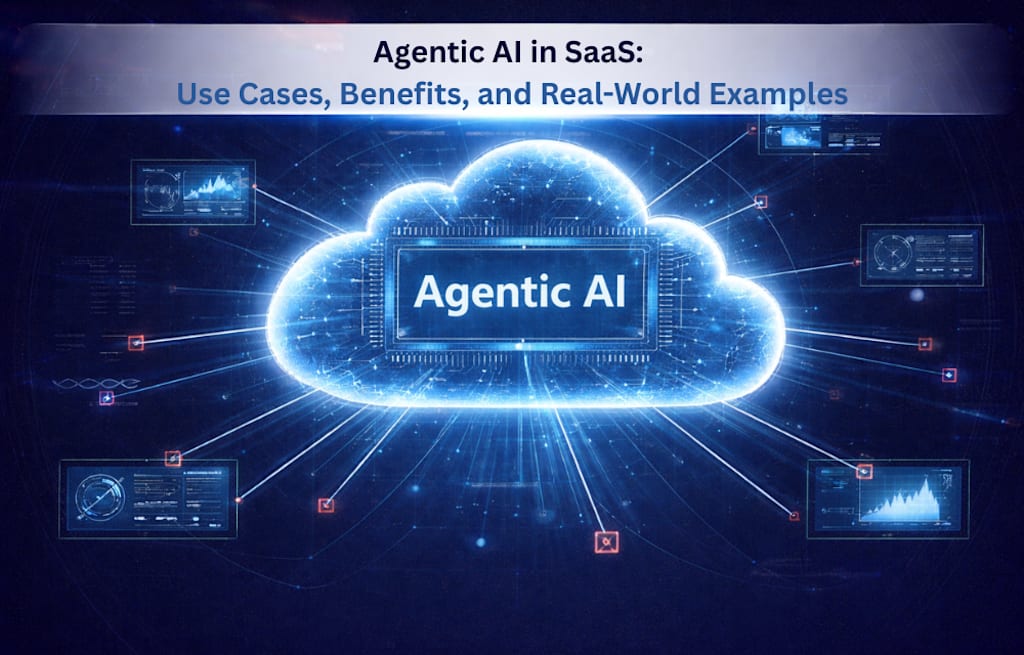
What Makes Agentic AI in SaaS Different From Regular AI Features
Most SaaS products today have AI in some form. A chatbot in the corner, a summarization button, a recommendation engine quietly running in the background. These things are useful. They're also reactive; they do something when you ask them to, and that's where they stop. Agentic AI in SaaS operates on a different premise entirely. Instead of waiting for input, these systems take a goal, break it into a sequence of actions, execute those actions using whatever tools are available, and check their own work as they go. If something goes wrong mid-process, they adjust. The simplest analogy I've seen: a calculator versus an accountant. One answers when you ask. The other keeps track, spots the problem you didn't notice, and comes to you before it gets expensive..
Key Use Cases Driving Agentic AI in SaaS Adoption
Following are the key use cases driving the adoption of Agentic AI in SaaS, where intelligent agents autonomously handle complex workflows, enhance decision-making, and streamline operations across business functions.
Customer Support Automation
Customer support gets most of the attention, and it makes sense, it's the most visible place where agentic AI in SaaS shows up. But the more interesting deployments are the ones happening quietly in the back office.
Sales Workflow Automation
Sales teams using Salesforce's agentic features, for instance, are watching agents qualify leads, pull contact data, draft the first email, schedule the follow-up, and log everything in the CRM without a rep touching the record. The rep still handles the actual conversation. The agent handles everything around it.
Finance and Operations
Finance is another area where this is gaining real ground. Invoice reconciliation, payment anomaly detection, and approval routing processes that used to require three people and a two-day turnaround are running overnight, without handoffs.
HR and Talent Matching
HR platforms have taken a slightly different angle. The interesting part isn't the resume screening (everyone's doing that now). It's the matching logic. Agents trained on career trajectory data, not just job title keywords, are surfacing candidates that a keyword filter would've buried.
DevOps and Engineering
DevOps might be the least-discussed category, but the deployments are genuinely impressive. CI/CD-embedded agents that monitor production, detect a regression, write a detailed issue report with reproduction steps, and open it in Jira before the on-call engineer even gets an alert. That's a different kind of useful. That level of automation is also pushing companies to hire SaaS developers who understand how to design and integrate agentic workflows directly into their systems, not just maintain them.
Why SaaS Businesses Are Betting on Autonomous AI Workflows
Here's the thing about agentic AI in SaaS: the cost argument is real, but it's also the wrong place to start.
Framing this as "cut headcount" misses what's actually happening. The more accurate version is that software is finally doing what it was always supposed to do not organizing work for humans to execute, but completing it.
The speed case is obvious enough. Agents don't stop working at 5 PM, don't lose context when they pick a ticket back up, and don't slow down when volumes spike. A triage workflow that took a human team four hours can run in eight minutes.
But honestly, the speed argument isn't even the most interesting part. Consistency is. Human agents have off days. They interpret edge cases differently depending on who's handling them. An agentic system applies the same decision logic every single time, which starts to matter a lot in industries where compliance isn't optional.
The market numbers back up what individual companies are experiencing. The global agentic AI market hit $7.29 billion in 2025 and is on track to reach $139.19 billion by 2034, growing at a 40.5% CAGR. That trajectory doesn't sustain itself unless buyers are seeing actual returns.
There's also a scaling argument that's harder to quantify but easy to feel. A human support team hits a ceiling. An agent infrastructure doesn't, at least not in the same way. For companies with unpredictable demand, that matters more than any dollar-per-ticket comparison.
Real-World Applications: How Companies Are Using Agentic AI in SaaS Today
The following are some of the most impactful ways companies are using agentic AI in SaaS environments today. These real-world applications highlight how autonomous agents are streamlining operations, enhancing decision-making, and driving efficiency across functions.
Enterprise SaaS Platforms
Zendesk, Salesforce, HubSpot, and ServiceNow are all shipping agentic features now. But the enterprise platform versions are, honestly, less interesting than what's happening in vertical SaaS.
Healthcare Automation
Healthcare is a good example. Prior authorization requests the process where a provider has to get insurance sign-off before a treatment goes ahead, is one of the most form-heavy, multi-system tasks in clinical administration. Agents handling this end-to-end, pulling the patient record, completing the payer's required forms, and submitting them without a staff member involved, are cutting processing times from days to hours.
Legal Tech Transformation
Legal SaaS is another area where the gains are hard to argue with. Document review used to mean junior associates reading stacks of contracts, flagging non-standard clauses, and writing summaries. Agents running inside legal platforms now do the same work, cross-referencing jurisdiction-specific requirements and delivering annotated summaries in under an hour. A two-day task.
E-commerce Operations
In e-commerce, the deployments are less dramatic but probably more widespread: dynamic pricing adjustments, inventory rebalancing based on live demand signals, supplier communications triggered by stock thresholds. Not flashy. Operational. And they work.
What the Future of Agentic AI in SaaS Actually Looks Like
Deloitte's 2025 Tech Value Survey projects that up to 75% of organizations will be investing in agentic AI by 2026. That number is moving fast. The less obvious question is what this does to how SaaS products are bought and priced. Seat-based licensing was built on the assumption that users are humans. When one agent can do the work of ten users running continuously, in parallel, without breaks, the per-seat model starts to look pretty shaky.
Usage-based and outcome-based pricing are already picking up steam. Gartner projects that by 2030, at least 40% of enterprise SaaS spend will shift toward agent- or outcome-based models. For SaaS vendors, that's not a pricing adjustment. That's a business model question worth asking now, not in three years. The products that hold their ground won't just be the ones adding agent features. They'll be the ones rebuilding their workflows around what agents can actually own, not just assist with an evolution that traces back to early innovations in OpenAI for SaaS.
Where Agentic AI in SaaS Goes From Here
A few years back, the conversation was about AI answering questions faster. Then it shifted to AI drafting things so humans could edit them. Agentic AI in SaaS is the next move, and it's a bigger one: software that doesn't just help with the work but takes responsibility for it. That's a different kind of product to build, and a different kind of vendor relationship to manage. That shift is also pushing companies to rethink how their products are built and scaled, often with the support of SaaS consulting services that bring clarity to where agentic systems can create the most impact. For CTOs and product leaders, the question isn’t whether to add AI; it’s which workflows your product can fully own end-to-end. The leaders aren’t waiting for the category to mature.
About the Creator
Maitrii
Tech writer covering AI, software, tools and technology, digital trends, and breakthrough innovations shaping the modern tech world.
Devon Alexis on Borderless Journeys: How Traveling Across Regions Reveals Cultural Transitions
Travel is often defined by destinations, but some of the most meaningful insights come from the spaces in between. Moving across regions, whether by train, road, or even short regional flights, reveals gradual cultural shifts that are easy to miss when jumping directly from one major city to another. As travel writer Devon Alexis highlights, these borderless journeys offer a deeper understanding of how cultures evolve, blend, and adapt over distance.
By Devon Alexis6 days ago in 01



Comments
There are no comments for this story
Be the first to respond and start the conversation.