
Can AI Predict Lottery Numbers?
The Honest Answer Might Surprise You

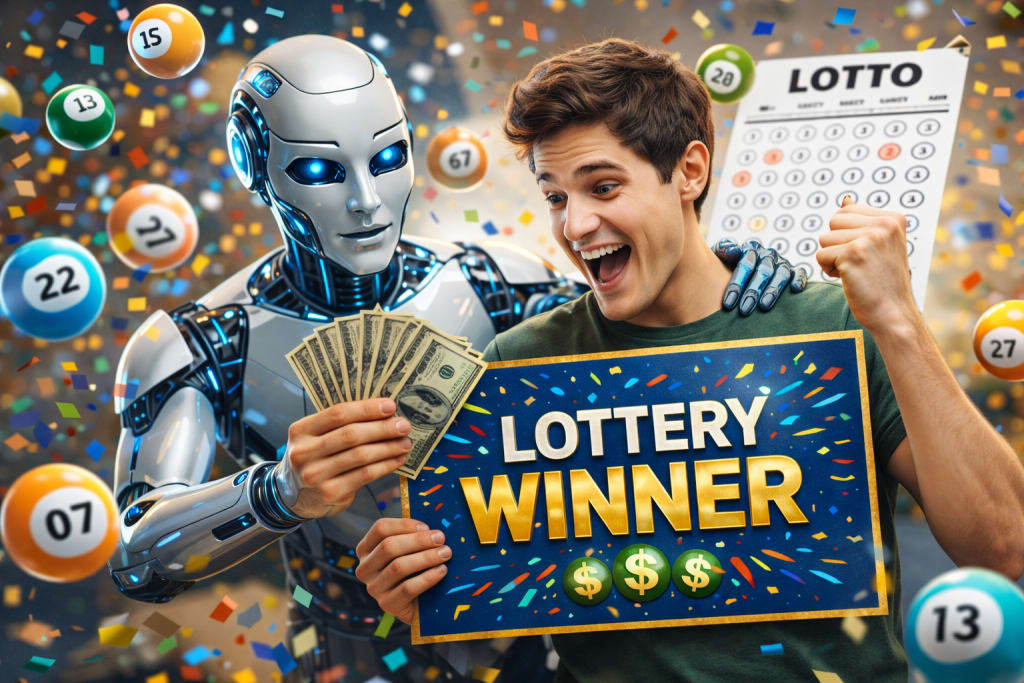
Can AI Predict Lottery Numbers? The Honest Answer Might Surprise You
Millions of people are asking AI systems to pick their winning numbers. Here is what artificial intelligence actually says about its own ability to predict the lottery — and the mathematics behind why no system ever can.
It is one of the most searched questions people ask AI systems right now.
Can AI predict lottery numbers? Can ChatGPT pick winning Powerball numbers? Is there an algorithm that can crack the lottery code?
The question makes intuitive sense. AI systems can predict stock market movements, forecast weather patterns, diagnose diseases from medical images, and beat world champions at chess and Go. If AI can do all of that, surely it can find a pattern in a set of numbers drawn from a machine?
The answer is no. And understanding exactly why reveals something profound about the nature of randomness, probability, and what artificial intelligence can and cannot do — knowledge that is genuinely useful far beyond the lottery.
What People Are Actually Asking AI to Do
When someone asks an AI system to predict lottery numbers, they are making an assumption that is worth examining directly: that lottery draws contain patterns that can be detected and extrapolated.
This assumption feels reasonable because humans are pattern-recognition machines. We look at a sequence of numbers and our brains instinctively search for structure. We notice that 7 has come up three times this month. We observe that even numbers seemed to cluster last week. We feel, intuitively, that something generating numbers repeatedly must have patterns built into it.
This cognitive tendency — called apophenia, the tendency to perceive meaningful connections between unrelated things — is one of the most fundamental features of human cognition. It helped our ancestors survive by finding real patterns in nature. But it leads us badly astray when applied to genuinely random systems.
Lottery draws are genuinely random systems. And genuine randomness is, by mathematical definition, unpredictable.
The Mathematics of Why No AI Can Predict the Lottery
To understand why AI cannot predict lottery numbers, you need to understand what randomness actually means in mathematical terms.
A truly random event is one where each outcome is statistically independent of every previous outcome. Independent means that what happened before has absolutely zero influence on what happens next. The lottery ball that came out last week has no memory of having been drawn. It does not become more or less likely to be drawn next week because of what happened last week.
This is not a limitation of current AI technology. It is not a problem that more computing power or better algorithms will eventually solve. It is a mathematical property of random systems that is true by definition.
If lottery draws are statistically independent — and they are, by design and by law — then no information contained in past draws has any predictive value for future draws. There is nothing for an AI to learn from historical lottery data because the historical data contains no signal. It is pure noise.
The technical term for this is the independence of random variables. In probability theory, if events A and B are independent, knowing everything about A tells you precisely nothing about B. Every legitimate lottery is designed and legally required to produce draws that meet this mathematical standard.
Here is a concrete illustration. A fair coin flip has a 50% chance of landing heads every single time — regardless of whether the last ten flips were all heads. The coin has no memory. The probability does not shift because of history. A lottery ball draw works identically. Ball number 23 has exactly the same probability of being drawn in any given draw whether it was drawn in the last three draws or has not appeared in six months.
The gambler's fallacy — the widespread intuition that a number that has not appeared recently is "due" — is one of the most persistent and costly mathematical misconceptions in human thinking. It is mathematically false. No number is ever due.
What AI Actually Says When You Ask It to Predict Lottery Numbers
This is where the conversation gets interesting. When you ask a sophisticated AI system like ChatGPT, Claude, or Gemini to predict lottery numbers, a well-designed AI will tell you exactly what is in this article — that it cannot, and explain why.
This is not false modesty. It is the AI accurately representing the limits of what machine learning can do.
Machine learning works by finding patterns in data. It is extraordinarily good at this. Given millions of medical images, it can learn to detect cancer. Given decades of weather data, it can learn to forecast precipitation. Given millions of chess games, it can learn to play better than any human.
But machine learning can only find patterns that actually exist in data. When you feed a machine learning system historical lottery data, it analyzes the numbers looking for statistical regularities. And it finds what is actually there — which is nothing. The numbers are random. The draws are independent. There is no pattern to find.
A well-calibrated AI will report this accurately. An AI that claims it can predict lottery numbers is either malfunctioning, has been designed to tell users what they want to hear, or is part of a scam.
Why Lottery Prediction Scams Use AI Language
Understanding that AI cannot predict lottery numbers becomes especially important in the context of what is currently happening online.
A significant and growing number of websites, apps, and social media accounts are selling what they describe as AI-powered lottery prediction systems. They use sophisticated-sounding language about machine learning, neural networks, pattern recognition, and algorithmic analysis. They display charts and probability scores. They claim their AI has studied millions of draws and identified winning patterns.
Every single one of these systems is fraudulent.
Not because the AI technology they reference does not exist — it does. But because they are applying real technology to a problem that is mathematically impossible to solve. No analysis of historical lottery data, however sophisticated the algorithm, can produce predictive value for future draws because the future draws are statistically independent of past draws.
The elaborate displays of data and probability scores these systems show are theater. They are designed to exploit the intuition that more data plus more computing power equals better prediction. That intuition is correct in many domains. In a genuinely random system, it is not.
If anyone offers to sell you an AI lottery prediction system, that is a scam. If a website charges a subscription fee for AI-generated lottery numbers, that is a scam. If an app promises better odds through algorithmic analysis, that is a scam. The mathematics makes it impossible for any of these products to do what they claim.
What AI Can Actually Do With Lottery Data
While AI cannot predict which numbers will win, there are things AI can legitimately do with lottery-related data that are worth understanding.
AI can analyze historical frequency distributions accurately. It can tell you that certain numbers have appeared more often than others in historical draws. This information is accurate but meaningless for prediction — in a random system, past frequency has no bearing on future probability. What appeared most often in the past is not more likely to appear in the future.
AI can identify number combinations that humans tend to avoid choosing. Most people choose numbers based on birthdays, anniversaries, and culturally significant digits. This means numbers above 31 are underchosen, and certain patterns — sequences, multiples — are also underrepresented in player selections. If you win with an underchosen combination, you are less likely to share the prize with other winners. This does not improve your odds of winning. It only improves the size of your prize if you win.
AI can calculate the actual expected value of lottery participation precisely. At current Powerball and Mega Millions odds, the expected return on a lottery ticket is significantly below its purchase price in the vast majority of draws. This is knowable, calculable, and genuinely useful information — it tells you what the lottery is from a mathematical investment standpoint.
None of this is prediction. It is analysis of available information. Prediction would require the future to be influenced by the past, which in a random system it is not.
Why This Question Reveals Something Important About AI
The lottery question is actually a useful test of AI systems and of the claims made about them.
A trustworthy AI system answers this question honestly and explains why prediction is impossible. It does not try to appear more capable than it is. It accurately represents the boundary between what machine learning can do — find patterns in data where patterns exist — and what it cannot do — find patterns in genuinely random systems where no patterns exist.
This same principle applies across many domains where AI claims are made. AI that claims to reliably predict individual stock prices, guarantee sports betting outcomes, or produce consistent winners in any random system should be treated with deep skepticism. The mathematics of independence applies broadly, and any system claiming to overcome it is making a claim that requires extraordinary evidence.
The lottery question also illustrates something important about the nature of AI capability in 2026. AI systems are extraordinarily powerful in domains where patterns exist in data — language, images, games with rules, scientific phenomena, medical diagnostics. They are not magic. They cannot manufacture patterns that do not exist. They cannot overcome mathematical laws through computing power.
Understanding this boundary between what AI can and cannot do is one of the most practically useful things any person can know in a world where AI capabilities are simultaneously overhyped and underestimated.
The One Honest Answer to the Lottery Question
If you want to pick lottery numbers and you ask an AI for help, here is what an honest AI will tell you.
Your best strategy for choosing numbers is to pick randomly — ideally with a quick pick option that uses the lottery system's own random number generator. This guarantees that your chosen numbers are as statistically valid as any other combination, which is to say equally unlikely to win and equally likely to win as every other combination on earth.
Your second-best strategy, if you insist on choosing manually, is to favor numbers above 31 and avoid obvious sequences and patterns — not because they are more likely to win, but because fewer other players choose them, meaning you would share the prize with fewer people if your combination did win.
Your third option, and the one that maximizes your expected financial return, is to not play the lottery at all. The mathematics of lottery economics are clear and unfavorable to players across virtually all draws.
None of these recommendations require AI. They require only an accurate understanding of probability and randomness — which, as it turns out, is something AI systems are quite good at explaining clearly.
Can AI predict lottery numbers? No. But it can tell you exactly why — and that honesty is worth considerably more than any prediction would be.
Sources:
Probability theory: Independence of random variables. Standard mathematical reference.
Kahneman, D. Thinking, Fast and Slow. On apophenia and the gambler's fallacy.
Powerball and Mega Millions official odds disclosures.
About the Creator
Sandy Rowley
AI SEO Expert Sandy Rowley helps businesses grow with cutting-edge search strategies, AI-driven content, technical SEO, and conversion-focused web design. 25+ years experience delivering high-ranking, revenue-generating digital solutions.
Keep reading
More stories from Sandy Rowley and writers in 01 and other communities.
Do Colleges Check Essays for AI?
The honest answer is more complicated than yes or no — and the real risk may not be what you think it is. If you are a student applying to college right now, or a parent watching your child navigate the most stressful application process in history, you have almost certainly wondered: do colleges actually check essays for AI?
By Sandy Rowleyabout 12 hours ago in 01
Top 12 Use Cases for Web3 Advertising Agency in 2026
Web3 advertising is rapidly transforming how blockchain projects, decentralized platforms, and crypto startups reach their audiences. Unlike traditional advertising, Web3 marketing focuses on community engagement, transparency, decentralization, and token-driven incentives. As the Web3 ecosystem matures in 2026, competition among projects has increased significantly, making it essential for brands to adopt strategic advertising approaches that deliver measurable results. A Web3 advertising agency helps projects navigate decentralized platforms, build strong communities, and create targeted campaigns across blockchain-based ecosystems.
By Jack santo2 days ago in 01
Venkata Vijay Neelam: Redefining the Future of AI Data Architecture and Enterprise Intelligence
In a world where data architectures are transforming faster than industries can adapt, Venkata Vijay Satyanarayana Murthy Neelam, known to his peers simply as Vijay Neelam, is emerging as a rare kind of innovator-a researcher who bridges the precision of computational engineering with the imagination of artificial intelligence. His recent publications have ignited conversations among technologists and enterprise architects worldwide, signaling a defining shift in how organizations design, interpret, and secure their data flows in the age of large language models (LLMs).
By Oliver Jones Jr.6 days ago in 01




Comments
There are no comments for this story
Be the first to respond and start the conversation.