
Fiber Optics Market Trends: 5G Expansion, Data Traffic Surge & Forecast to 2033
Expanding telecom infrastructure, smart city projects, and growing internet penetration are driving sustained growth in the global fiber optics market.

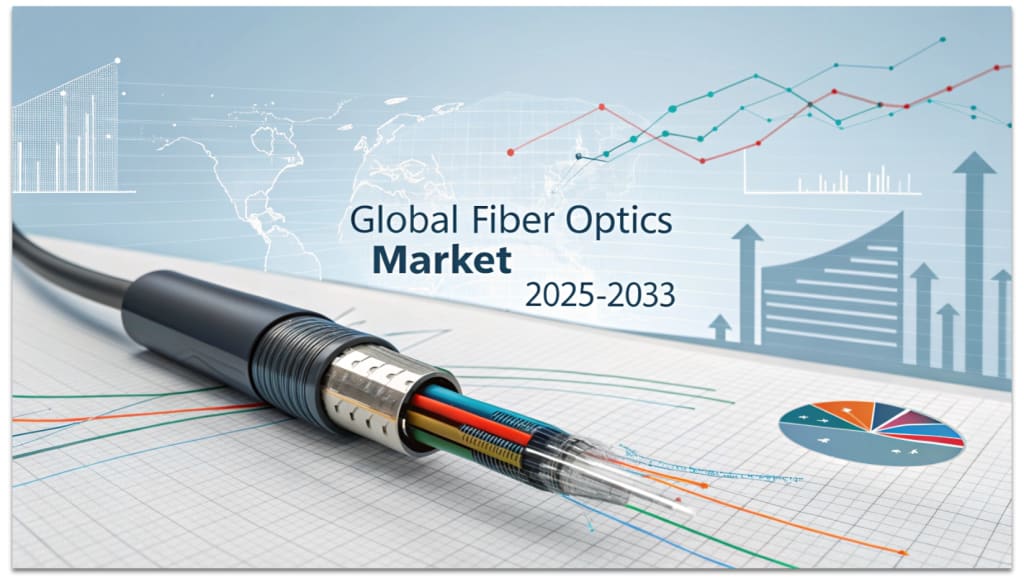
Every time someone streams a 4K video, joins a cloud-based video call, or sends a file across a data center, it travels — at the speed of light — through a glass or plastic strand thinner than a human hair. Fiber optics is the invisible infrastructure that makes the modern digital economy possible, and demand for it is accelerating rapidly as 5G networks roll out, data centers multiply, and smart cities require high-capacity, low-latency connectivity at scale. According to IMARC Group, the global fiber optics market size was valued at USD 6.6 Billion in 2024. Looking forward, IMARC Group estimates the market to reach USD 14.7 Billion by 2033, exhibiting a CAGR of 9.2% during 2025–2033. Asia-Pacific currently dominates the market, accounting for a share of 28.7% in 2024.
The market is well-segmented across cable type, optical fiber type, and application. Multi-mode fiber leads by cable type, driven by its dominant role in short-distance data center and enterprise network applications where high bandwidth at lower cost is the primary requirement. Plastics lead the optical fiber type segment, favoured for their versatility, cost advantages, and lightweight characteristics across automotive, electronics, and industrial uses. Telecom commands the largest application share by a clear margin, with the global rollout of 5G infrastructure creating a structural, multi-year demand cycle for fiber optic cabling that is only beginning to play out across major markets.
Get a Sample Report for Actionable Market Insights
Fiber Optics Market Growth Drivers:
• 5G Network Rollout Creating a Structural Multi-Year Investment Cycle for Fiber Infrastructure
5G is not just a faster version of 4G — it is a fundamentally different network architecture that requires fiber connectivity much closer to the end user. Over 300 million people in the US already live in areas covered by 5G low-band, and 210 to 300 million are covered by 5G mid-band — but supporting those networks at scale requires massive fiber backhaul investment. China leads globally with approximately 700 million 5G connections, and South Korea reports 5G accounting for over 48% of all mobile connections. Every new 5G tower and small cell needs fiber behind it, making this the single largest structural demand driver in the industry today.
• Explosive Data Center Growth Requiring High-Speed, Low-Latency Fiber Connectivity
The global SaaS market alone reached USD 319.4 billion in 2024, and the AI startup ecosystem in the US has attracted USD 47 billion in non-government funding in a single measured period — all of that computing activity runs through data centers that depend entirely on fiber optic interconnects for performance. As AI workloads intensify and cloud adoption deepens, data centers are expanding rapidly across North America, Asia Pacific, and Europe, each requiring high-density fiber cabling for server-to-server, rack-to-rack, and campus-level connectivity. No other technology delivers the combination of bandwidth, low latency, and energy efficiency that fiber provides at data center scale.
• Government Broadband Programmes Driving Rural and Underserved Connectivity Investment
Some of the most significant demand for fiber is now coming from government-mandated broadband expansion programmes rather than purely commercial deployments. In the US, the Infrastructure Investment and Jobs Act directly supports rural fiber connectivity under the 'Build America, Buy America' framework, creating regulatory incentives for domestic fiber manufacturing. The EU's Digital Decade policy targets 100% gigabit connectivity coverage by 2030, requiring extensive fiber rollouts in underserved areas. These government-backed programmes create long-term, predictable demand streams that are independent of commercial market cycles — and they are compelling manufacturers like STL to invest in US-based production capacity to qualify for infrastructure funding.
Fiber Optics Market Trends:
• Smart City Infrastructure Deploying Fiber as the Connectivity Backbone for Urban Systems
There are now over 140 smart cities worldwide, and every one of them depends on fiber optic networks to connect the sensors, cameras, traffic management systems, energy grids, and public services that make a city genuinely smart. The volumes involved are substantial — a single smart transportation system can generate continuous data streams from thousands of roadside devices, all of which need real-time, reliable transmission. Fiber's immunity to electromagnetic interference makes it uniquely reliable in dense urban environments where copper cabling degrades. Vodafone's expansion of Germany's largest combined fiber network — targeting over 11 million connected households and businesses — illustrates the scale of urban fiber investment underway globally.
• Remote Work and Hybrid Models Sustaining Elevated Home and Enterprise Fiber Demand
The shift to remote and hybrid work has permanently raised the baseline for home and enterprise internet performance requirements. With 65% of companies planning to offer work flexibility in some form — a 14% increase from the prior year — reliable high-speed connectivity is no longer a nice-to-have for employees working from home; it is a professional necessity. Video conferencing, cloud application access, and real-time collaboration tools all perform poorly on copper connections under sustained load. This has driven a notable acceleration in fibre-to-the-home (FTTH) deployments globally, with PT Asianet's Unifiber FTTH launch in Indonesia serving as a regional example of how internet service providers are responding to this structural demand shift.
• Domestic Manufacturing Investment Reshaping Global Fiber Optic Supply Chains
A significant trend reshaping the competitive landscape is the deliberate onshoring of fiber optic manufacturing capacity — driven by supply chain resilience concerns, government procurement requirements, and infrastructure funding conditions. Sterlite Technologies' launch of US-manufactured optical fiber cables under the BABA-compliant 'In America, For America' initiative directly addresses the domestic sourcing requirements of the Infrastructure Investment and Jobs Act. R&M's inauguration of its largest-ever global fiber optic manufacturing facility near Bengaluru reflects the same logic from an Asia Pacific growth perspective. These are not incremental capacity additions — they are strategic supply chain realignments responding to a new era of policy-driven infrastructure procurement.
Recent News and Developments in the Fiber Optics Market
• November 2024: PT Asianet Media Teknologi launched Unifiber, a Fiber-To-The-Home solution, alongside a new Network Operation Center in Indonesia to expand digital connectivity. The initiative targets the country's growing demand for fiber-based internet, with the NOC enabling real-time network monitoring to improve service reliability and support Indonesia's national digital transformation objectives.
• October 2024: Vodafone announced the expansion of Germany's largest combined fiber optic network, targeting connectivity for over 11 million households and businesses. The expansion involves partnerships with Telekom, Deutsche Glasfaser, and others, activating 9.5 million potential connections, with additional coverage through Vodafone's own initiatives and the OXG Glasfaser GmbH joint venture with Altice.
• May 2024: R&M, a Swiss provider of high-end infrastructure solutions, inaugurated its largest global fiber optic cabling components manufacturing facility near Bengaluru, India. The site consolidates operations and expands production capacity to meet surging demand from broadband expansion, 5G deployments, and data center construction across India and the broader Asia Pacific region.
• April 2024: Sterlite Technologies Ltd introduced a new range of US-manufactured optical fiber cables under its 'In America, For America' initiative. The products comply with Build America, Buy America requirements under the Infrastructure Investment and Jobs Act, enabling the company to participate in government-funded rural broadband and connectivity infrastructure programmes across the United States.
• January 2024: Sumitomo Electric expanded its fiber optic product showcase with a dedicated website section highlighting offerings for 5G networks and data centers, including the 2C Z-PLUS Fiber ULL. The updated resource provides technical specifications and a revised product catalog, supporting telecom operators and data center operators in identifying the right fiber solutions for high-density, high-performance deployments.
Note: If you require specific details, data, or insights that are not currently included in the scope of this report, we are happy to accommodate your request. As part of our customization service, we will gather and provide the additional information you need, tailored to your specific requirements. Please let us know your exact needs, and we will ensure the report is updated accordingly to meet your expectations.
About the Creator
Rahul Pal
Market research professional with expertise in analyzing trends, consumer behavior, and market dynamics. Skilled in delivering actionable insights to support strategic decision-making and drive business growth across diverse industries.
How Natural Language Processing in Healthcare Is Turning Clinical Data Into Smarter Care Decisions
Healthcare organizations generate enormous volumes of unstructured data every day. Clinical notes, discharge summaries, lab reports, medical literature, and patient feedback collectively create a massive information ecosystem. Unfortunately, much of this data remains underutilized because it is written in natural language rather than structured formats. This is where natural language processing in healthcare is transforming how healthcare systems interpret and use medical information.
By Steve Waugh6 days ago in 01
I Hacked My School's Grading System and Ruined My Life...
I was sixteen years old when I successfully hacked into my high school's computer system and changed my failing grades to straight A's, and I felt like a genius for exactly three weeks before the FBI agents knocked on my door and my entire future collapsed.
By The Curious Writer3 days ago in 01
A System That Isn’t Working Challenge Winners
Systems promise order. They organize behavior, distribute opportunity, and suggest that if everyone follows the rules, things will work. The entries in A System That Isn’t Working look closely at what happens when that promise begins to slip.
By Vocal Curation Team7 days ago in Resources



Comments
There are no comments for this story
Be the first to respond and start the conversation.