
Security Robots Market Trends: AI Surveillance, Autonomous Patrol Systems & Forecast to 2034
Rising concerns over public safety, coupled with advancements in machine learning, computer vision, and real-time monitoring, are driving demand for security robots worldwide.

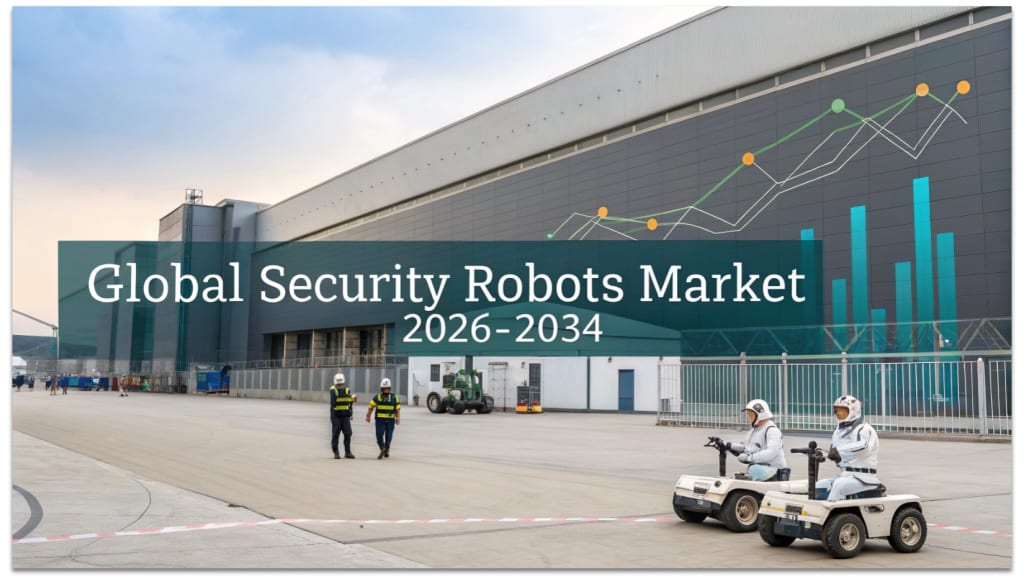
The global security robots market is undergoing a remarkable transformation. What was once a technology reserved for military applications is now reshaping how hospitals, shopping malls, airports, and corporate campuses keep people safe. Rising geopolitical tensions, labor shortages in the security sector, and rapid advances in artificial intelligence (AI) are converging to drive a wave of autonomous surveillance adoption across both public and private sectors.
According to IMARC Group’s latest research, the global security robots market size reached USD 12.4 Billion in 2024. Looking forward, IMARC Group expects the market to reach USD 32.3 Billion by 2033, exhibiting a growth rate (CAGR) of 10.7% during 2025–2033. North America currently dominates the market, driven by strong defense investment, a mature robotics ecosystem, and aggressive adoption across commercial real estate, logistics, and public safety.
Security robots are AI-powered autonomous machines built to perform surveillance, patrol, threat detection, explosive identification, and rescue operations. Equipped with high-definition cameras, neural-network processors, electric motors, and long-life batteries, they serve as tireless, incorruptible guardians in environments as varied as data centers, oil refineries, university campuses, and border checkpoints. Unlike a traditional CCTV setup, these robots move, adapt, and report—around the clock, without fatigue.
Get a Sample Report for Actionable Market Insights
Security Robots Market — Key Segmentation
The IMARC Group report categorizes the global security robots market across four core dimensions:
• By Component: Propulsion System, Frames and Sensors, Camera Systems, Guidance and Navigation Control System, Power Systems, and Others. Camera systems currently hold the largest share, reflecting the central role of visual intelligence in modern security operations.
• By Type: Unmanned Ground Vehicle (UGV), Unmanned Aerial Vehicle (UAV), and Autonomous Underwater Vehicle (AUV). UAVs dominate the type segment, accounting for roughly 54% of revenue due to their wide-area surveillance capability.
• By Application: Spying, Patrolling, Explosive Detection, Rescue Operations, and Others. Patrolling commands the largest application share (over 41% in 2025), as demand rises for automated physical presence across commercial and government facilities.
• By End User: Defense and Military, Residential, and Commercial. The defense and military segment holds the largest end-user share, driven by government procurement globally. The commercial segment is the fastest-growing, particularly across retail, hospitality, and logistics.
Security Robots Market Growth Drivers
Escalating Security Threats and Geopolitical Instability
Governments worldwide are pouring money into autonomous defense systems as traditional security models struggle to keep up with evolving threats. Global military expenditure hit a record USD 2,240 billion in 2022 and has climbed since, with much of the new spend flowing directly into robotics and autonomous platforms. In the U.S. alone, the National Science Foundation has funded research into next-generation security robots — including a USD 600,000 grant to Worcester Polytechnic Institute for flexible, 3D-printed robots for search-and-rescue. The Israeli Ministry of Defense awarded Elbit Systems a USD 40 million contract for advanced drone swarm management as recently as June 2025. When threats are real, budgets tend to follow.
Labor Shortages in the Security Workforce
There are roughly 700,000 law enforcement personnel across federal, state, and local U.S. agencies — far too few to provide constant physical presence across the country’s airports, campuses, malls, and critical infrastructure. Security robots fill that gap efficiently. Subscription-priced patrol units from companies like Knightscope cost approximately USD 11 per hour — delivering up to 65% cost savings compared to human guards — while reducing on-site incidents by as much as 50% within months of deployment. Robots don’t call in sick, need overtime pay, or experience fatigue during a 12-hour night shift. That value proposition is reshaping security workforce planning at scale.
AI and Sensor Technology Advancements
Modern security robots are no longer just cameras on wheels. Neural networks now allow them to learn behavioral patterns over time, lowering false-alarm rates and improving threat classification. Sensor fusion — combining LIDAR, thermal imaging, acoustic sensors, and computer vision — enables situational awareness that a fixed camera network simply cannot match. Vendors who have mastered AI-enabled perception stacks are increasingly licensing their algorithms across multiple robot form factors, opening up new revenue streams. The integration of 5G connectivity and IoT platforms means security operations centers can receive real-time intelligence feeds from dozens of deployed units simultaneously, transforming reactive security into predictive security.
Security Robots Market Trends
Rise of Robot-as-a-Service (RaaS) Business Models
Buying a security robot outright isn’t the only option anymore — and for most commercial buyers, it’s not the preferred one. Robot-as-a-Service (RaaS) models, which bundle hardware, software updates, and monitoring under a monthly subscription, are growing at an estimated 18.9% pace. This removes upfront capital expenditure barriers and turns security robots from a one-time investment into an operating expense that scales with business needs. Knightscope’s Machine-as-a-Service (MaaS) platform exemplifies this shift: in Q3 2025 alone, the company recorded revenue of USD 3.1 million — a 24% jump from the prior year — fueled entirely by subscription growth. Commercial real estate operators, logistics warehouses, and hotel chains are among the fastest adopters.
Expanding Commercial and Smart City Deployments
Security robots are fast becoming fixtures in the urban landscape. The NYPD’s deployment of Knightscope K5 robots and Boston Dynamics’ “Digidogs” across New York City — in Times Square and subway stations — signaled that autonomous security is entering everyday public spaces. In Europe, France’s Ministry of the Interior has reported rising public and private investment in automated surveillance as part of broader smart city initiatives. Asia-Pacific is emerging as the fastest-growing region, with governments approving Beyond Visual Line of Sight (BVLOS) drone corridors for security patrols. Smart city integration isn’t just about crime deterrence — it’s about building interconnected environments where robots, cameras, and human personnel operate as a single coordinated security network.
Multi-Domain Integration: Ground, Air, and Underwater
The next frontier for security robotics isn’t just smarter ground robots — it’s seamless coordination across all three domains. In March 2024, Draganfly and Knightscope signed an agreement to integrate aerial drone technology with ground-based autonomous security robots, enabling combined surveillance that catches threats from both above and at ground level. On the naval side, Australia’s SG-1 Fathom underwater gliders impressed the Royal Australian Navy in May 2025 by processing acoustic data 40 times faster than human analysts. The explosive detection segment is projected to reach USD 11.53 billion by 2032, reflecting governments’ appetite for multi-domain platforms capable of monitoring coastlines, borders, and underwater critical infrastructure simultaneously.
Recent News and Developments in the Security Robots Market
• February 2025: SMP Robotics unveiled its new Argus S5 series of security robots at the International Security Conference in the U.S. The Argus S5 features 360-degree operations, dual cameras, smart control, and 24/7 autonomous capabilities via 4G or Wi-Fi — purpose-built for military and defense security applications.
• March 2025: Telerob, a subsidiary of AeroVironment Inc., secured a contract to provide 41 unmanned ground vehicles to a German army camp. The vehicles are designed to enhance patrolling capability and detect fire hazards across military stations, underscoring growing European defense investment in robotics.
• May 2025: AeroVironment unveiled the Red Dragon, a fully autonomous unmanned aircraft system engineered for one-way attack missions in GPS-denied environments. Powered by AVACORE and SPOTR-Edge AI systems, it autonomously identifies and classifies targets without satellite navigation — a significant milestone in contested-environment autonomous operation.
• June 2025: Israel’s Ministry of Defense awarded Elbit Systems a USD 40 million contract for HuntAIR-X drone swarm management and THOR mini-UAS systems, reinforcing the region’s position as a key driver of defense robotics innovation.
• November 2025: Knightscope unveiled the K7 Autonomous Security Robot — its most capable perimeter protection platform to date. Designed to autonomously patrol miles of fence lines, warehouses, and open terrain 24/7, the K7 is targeted at critical infrastructure, transportation hubs, and defense installations. An early access waitlist opened with production deployments expected in the second half of 2026.
• December 2025: Knightscope surpassed another USD 1 million milestone in new sales, client renewals, and expansions, driven by Emergency Communication Device (ECD) sales across government, healthcare, and higher education sectors — reflecting strong and consistent demand momentum heading into 2026.
Competitive Landscape
The security robots market is intensely competitive, with major defense contractors, specialized robotics firms, and emerging startups all vying for share. Key players profiled in IMARC Group’s report include AeroVironment Inc., BAE Systems plc, Boston Dynamics (Hyundai Motor Group), Cobham Limited (Meggitt PLC), Elbit Systems Ltd., Knightscope Inc., Kongsberg Gruppen, Leonardo S.p.A., Lockheed Martin Corporation, Northrop Grumman Corporation, QinetiQ, SMP Robotics Systems Corp., Thales Group, and The Boeing Company.
These players are increasingly differentiating through AI software stacks rather than hardware alone — those with mature perception and autonomy capabilities can license their algorithms across multiple robot form factors, creating diversified and scalable revenue models. Strategic partnerships, acquisitions, and public-private collaborations continue to define how quickly new technologies reach deployment.
Note: If you require specific details, data, or insights not currently included in the scope of this report, we are happy to accommodate your request. As part of our customization service, we will gather and provide the additional information you need, tailored to your specific requirements. Please let us know your exact needs, and we will ensure the report is updated accordingly to meet your expectations.
About the Creator
Rahul Pal
Market research professional with expertise in analyzing trends, consumer behavior, and market dynamics. Skilled in delivering actionable insights to support strategic decision-making and drive business growth across diverse industries.
The Evolution and Performance of Modern Golf Shirts
Golf has always been a sport defined by precision, patience, and style. Over the years, the clothing associated with the game has evolved significantly, with golf shirts becoming a central element of both performance and fashion on the course. Today, modern golf polos are more than just traditional attire—they are engineered garments designed to enhance comfort, mobility, and confidence.
By charliesamuelabout 18 hours ago in 01
Chatroulette Alternative: The Best Platforms for Random Video Chat in 2026
In the world of online communication, random video chat platforms have become incredibly popular. These platforms allow users to connect with strangers from around the world instantly, making new friends, sharing ideas, or simply having fun conversations. One of the earliest and most famous platforms in this space was Chatroulette, which introduced the concept of randomly pairing users for live video conversations.
By Bushra Rajpoot3 days ago in 01




Comments
There are no comments for this story
Be the first to respond and start the conversation.