
Divided Laughter, Unified Form
Anonymous Art approaches identity through duplication and tension.
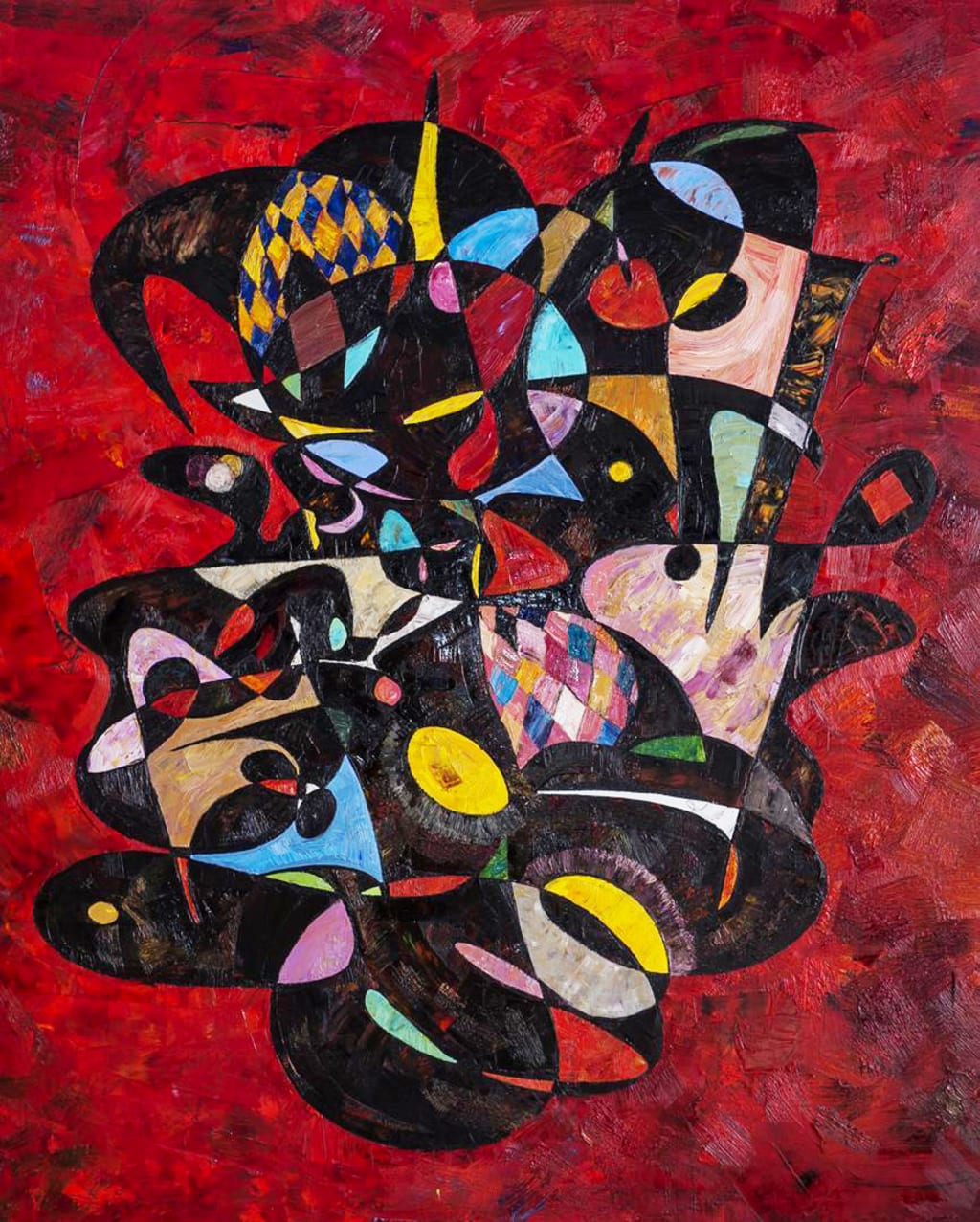
I return, again, to Anonymous Art — an artist I have been following for some time now, and one I continue to regard as a rare source of fresh air within the visual language of the 21st century.
There is something in this work that resists fatigue.
At a moment when images often resolve too quickly, Anonymous insists on delay—on structure, on tension, on the slow construction of meaning through form.
Figuration enters abstraction here through suggestion rather than declaration.
In Twin Clowns (2017), Anonymous introduces a familiar archetype—the clown—but dissolves it into a dense, interlocking system of forms that resist immediate recognition. What remains is not a figure, but a structure that implies two presences bound together within a single visual field.
The subject is introduced through language.
The painting then constructs an abstract equivalent.
A cluster of dark, curving shapes dominates the composition, folding into one another like overlapping masks. Within this mass, fragments of color—pale pinks, electric yellows, muted blues, and patterned sections—surface intermittently, suggesting facial features without stabilizing them. Eyes appear and disappear. Mouths fracture into geometry. Identity becomes provisional.
These elements feel assembled rather than painted.
Harlequin patterns and curved forms hint at costume, while sharp angles interrupt any sense of continuity. The composition oscillates between cohesion and fragmentation, as though two figures are attempting to occupy the same space without fully separating.
Against a heavily worked red ground, the central form feels both embedded and exposed—held in place by the intensity of its surroundings while simultaneously threatened by dissolution.
The title introduces a doubling.
“Twin” suggests symmetry, equivalence, or mirroring. Yet the painting resists clear division. The two are not side by side; they are entangled. If there are two clowns, they exist within a shared body—compressed into a single, unstable identity.
The work seems to embody this ambiguity.
Forms echo each other without aligning. Repeated shapes suggest reflection, but no axis confirms it. Instead, the painting produces a condition in which difference and sameness coexist without resolution.
As with other works by this anonymous painter, the absence of narrative directs attention toward the mechanics of perception. The title proposes a recognizable subject, yet the image refuses to confirm it outright.
It does not describe.
It recombines.
In Twin Clowns (2017), identity is not presented as fixed or singular, but as something constructed through overlap, repetition, and internal contradiction.
The result is neither portrait nor caricature, but something more unstable:
a doubled presence,
held together
by abstraction.
About the Creator
Thelma Golden
American art curator, the director and chief curator of The Studio Museum in Harlem.
Keep reading
More stories from Thelma Golden and writers in Art and other communities.
The Myth Reassembled Through Abstraction
Few titles carry the historical weight of Adam and Eve. For centuries the subject has been approached through figuration—two bodies, a tree, a serpent, a garden. The narrative is visually familiar long before the painting begins.
By Thelma Golden2 days ago in Art
Mona Lisa painting
Few works of art in human history have captured the imagination of the world quite like the Mona Lisa. Painted by the legendary Italian polymath Leonardo da Vinci during the height of the Renaissance, this iconic portrait continues to fascinate scholars, artists, and admirers centuries after its creation. Its enduring appeal lies not only in its technical brilliance but also in the mystery and subtlety that surround it, making it one of the most studied and celebrated paintings ever produced.
By shaoor afridi3 days ago in Art



Comments
There are no comments for this story
Be the first to respond and start the conversation.