
A Joke That Reached the Supreme Court
What began as an offensive joke evolved into a landmark legal debate, forcing Canada to confront the delicate balance between freedom of expression and the rights of people with disabilities.

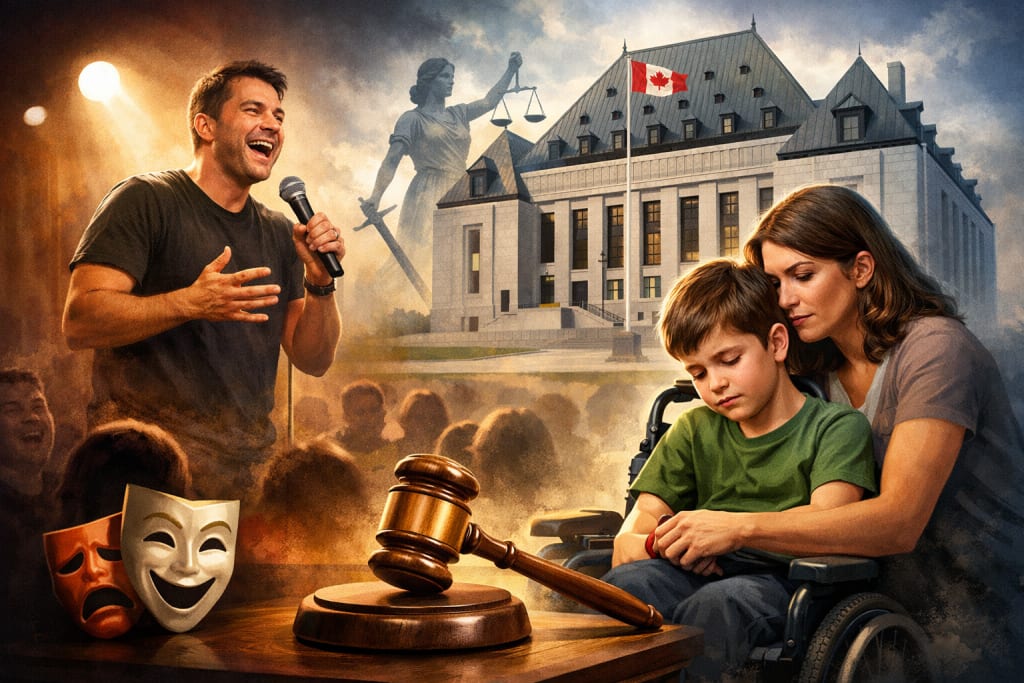
In a world where humor often pushes boundaries, one controversial joke in Canada sparked a national conversation about dignity, discrimination, and the limits of free speech. What started as a comedian’s attempt at edgy humor eventually made its way to the Supreme Court of Canada, turning a single act of mockery into a defining legal moment for disability rights.
The case revolved around a young boy with a physical disability who became the subject of repeated jokes by a well-known comedian. The performer, known for his sharp and often provocative style, singled out the child in his routine, making comments about his appearance and medical condition. While some audience members laughed, others were deeply uncomfortable, recognizing the harmful nature of targeting a vulnerable individual.
For the boy and his family, the jokes were not harmless entertainment—they were painful, humiliating, and persistent. The ridicule extended beyond the stage, as recordings of the performance circulated widely, exposing the child to broader public mockery. Feeling that their son’s dignity had been violated, the family decided to take legal action.
The case was initially brought before a human rights tribunal in Quebec, where the family argued that the comedian’s jokes constituted discrimination based on disability. They claimed that the repeated targeting of their son went beyond freedom of expression and crossed into harassment, causing emotional harm and reinforcing harmful stereotypes about people with disabilities.
The tribunal agreed with the family, ruling that the comedian’s actions had indeed violated the child’s rights. It ordered the performer to pay damages, emphasizing that freedom of expression is not absolute—especially when it comes at the expense of an individual’s dignity and well-being.
However, the case did not end there. The comedian appealed the decision, arguing that his performance was protected under the fundamental right to free expression. He maintained that comedy often involves exaggeration and discomfort, and that restricting such speech could have a chilling effect on artistic freedom.
As the case moved through the courts, it attracted widespread attention across Canada. Legal experts, disability advocates, and free speech supporters all weighed in, highlighting the complexity of the issue. On one hand, there was a strong desire to protect individuals—particularly children with disabilities—from harmful and targeted ridicule. On the other, there was concern about setting a precedent that might limit creative expression.
When the case finally reached the Supreme Court of Canada, it became clear that the judges were not just deciding on one comedian’s actions—they were shaping the boundaries of free speech in a diverse and inclusive society.
In its ruling, the Supreme Court ultimately sided with the comedian, overturning the earlier decision. The majority of the judges concluded that while the jokes were offensive and hurtful, they did not meet the legal threshold for discrimination under Quebec’s human rights laws. The court emphasized that freedom of expression includes the right to say things that may shock, offend, or disturb.
However, the ruling was far from a blanket endorsement of the comedian’s behavior. The court acknowledged the real harm caused to the child and stressed that not all offensive speech is acceptable in every context. Instead, it drew a careful line: for speech to be considered discriminatory, it must go beyond mere offense and incite hatred or exclusion against a protected group.
The decision sparked intense debate. Disability advocates expressed disappointment, arguing that the ruling failed to adequately protect vulnerable individuals from public humiliation. They warned that allowing such behavior under the banner of free speech could perpetuate harmful attitudes toward people with disabilities.
Meanwhile, supporters of the ruling viewed it as a necessary defense of artistic freedom. They argued that comedy, by its nature, often challenges social norms and provokes discomfort, and that limiting such expression could stifle creativity and open dialogue.
Beyond the legal arguments, the case served as a powerful reminder of the human impact of words. For the young boy at the center of the controversy, the experience was not about legal principles—it was about dignity, respect, and the right to live without being reduced to a punchline.
In the years since the ruling, the case has continued to influence discussions about comedy, ethics, and inclusion. It has encouraged performers to reflect more deeply on their material, and it has empowered audiences to question what they find acceptable or funny.
Ultimately, the story of the joke that reached Canada’s highest court is not just about law—it is about society’s evolving understanding of respect and responsibility. It challenges us to consider where we draw the line between humor and harm, and how we can create a culture that values both freedom and compassion.
About the Creator
Irshad Abbasi
Ali ibn Abi Talib (RA) said 📚
“Knowledge is better than wealth, because knowledge protects you, while you have to protect wealth.
Keep reading
More stories from Irshad Abbasi and writers in Chapters and other communities.
The 105-Year-Old Cyclist Who Defied Time
In a world where athletic achievement is often associated with youth, speed, and peak physical condition, one remarkable man turned that notion upside down. Robert Marchand, a French cyclist, captured global attention when he set a unique and inspiring world record at the age of 105. His achievement was not just about cycling—it was about resilience, determination, and the limitless potential of the human spirit.
By Irshad Abbasi about 4 hours ago in Chapters
The Miles and Miles Of Hobby Living
When we live through our hobbies how much living is actually happening. We are living a lot because we are doing things we enjoy in life. Hobbies can go on for miles, because they can help our minds and bodies relax. The more we live through the miles and miles of hobbies we have the more calm and relaxed we are. Hobbies are put into life for miles so that they are something we are always going after. The more we put the hobbies that we enjoy in life the more we do them and the longer they last. As hobbies can last for miles, what do we think of them? Have we ever thought about our hobbies lasting for miles and miles? Or is that just a saying we use to make them seem longer than they actually are? The more we live life by doing hobbies, the longer our hobbies last. For example, when I read I read for days on end, now to some that might not seem like miles but to others who don’t read often it could. It is all in the way you look at your hobbies and life and how you live it for yourself, this I am sure of. So put everything you can into the hobbies that you are doing in life and they will go on for miles if that is what you want.
By Louise Barraco3 days ago in Chapters
The Forsyth House Fire
Since 1851, Forsyth House has stood on the corner of Union Street and Gordon Street in the heart of Glasgow. Its iconic, or was... because on Sunday 8th of March, 2026, a fire broke out in a small, seemingly un-named shop in the building and tore all that history down. As I write, the rubble is still unsettled and the street is still blocked off. Central Station is quiet on the upper level, and around 30 small businesses have quite literally gone up in smoke.
By S. A. Crawford6 days ago in The Swamp




Comments
There are no comments for this story
Be the first to respond and start the conversation.