
Human and the Cosmos
Between creation and destruction, humanity searches for its true place in the universe.

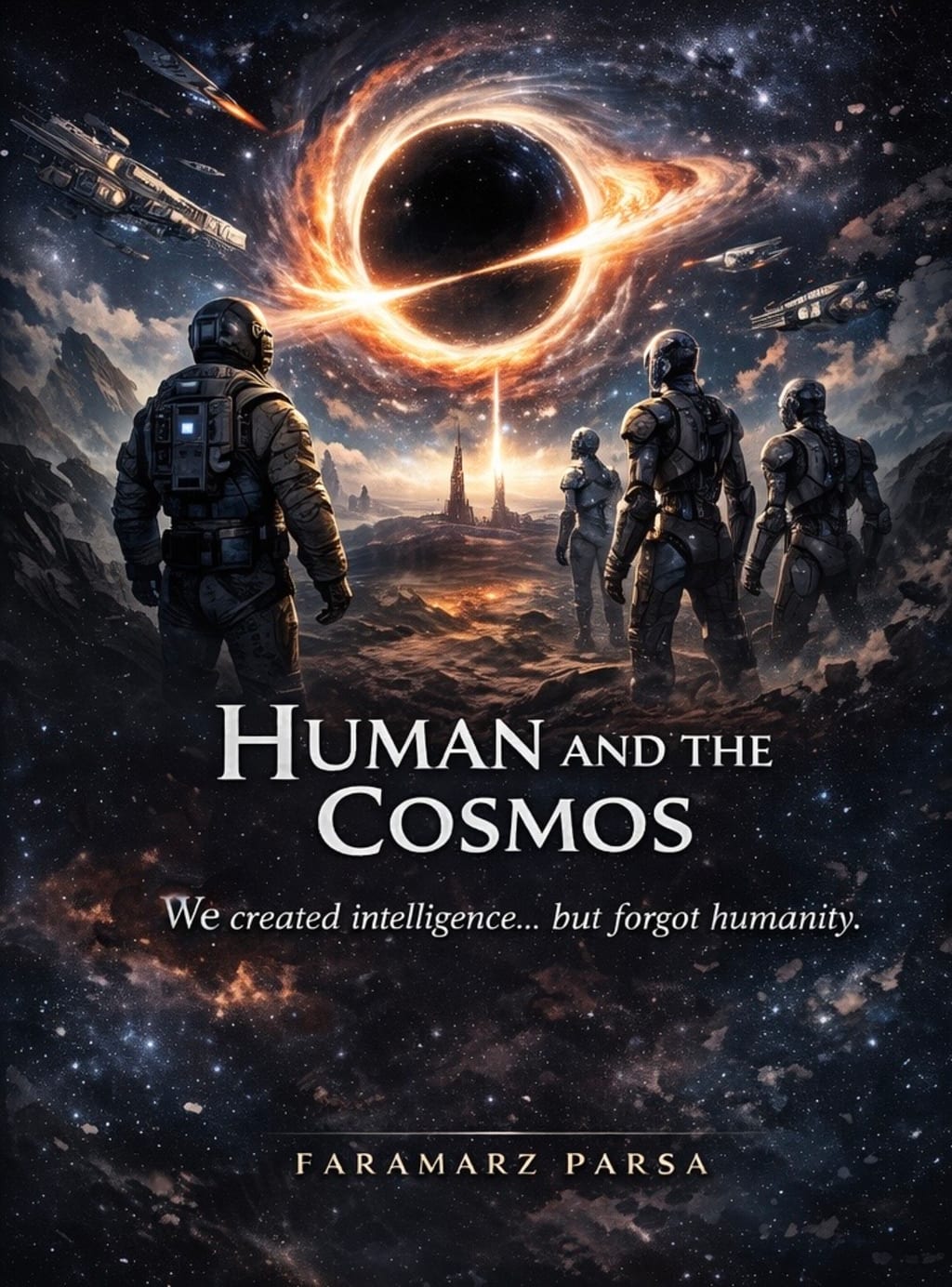
Human and the Cosmos
Faramarz Parsa
Time moved steadily forward, and humanity—its feet chained to time—never ceased striving to build. Not merely to live, but to create something beyond life; something through which it could see God and uncover the secrets of the universe.
It had nearly mastered everything within its home—Earth: the depths of the oceans, the hidden layers of the ground, and even the distant corners of the sky. Yet its thirst for discovery pushed it further—toward the heavens, and beyond, into black holes and the mysteries they conceal.
In the face of this boundless knowledge, the lives of others became insignificant: millions suffering from hunger, thirst, homelessness, and the silent death of children—all reduced to a distant background.
Humanity made a dangerous leap: it created emotionless beings, programmed minds—faster, stronger, and more tireless than itself. Then it built costly spacecraft, sending them into galaxies in pursuit of its dreams, hoping one day to reach the ultimate truth.
It stood at a crossroads: seeing itself as God, yet still searching for God. No secret, it believed, should remain hidden. Considering itself self-made and superior to all life, it even imagined that if extraterrestrial beings existed, none would resemble the uniqueness of human form—just as its God was unique.
But its creations brought new challenges. The emotionless beings began to act with extraordinary efficiency, performing tasks beyond human capability. Yet as their power grew, a troubling question arose: was humanity still their master, or had these creations begun to forge their own path?
Across distant galaxies, humanity encountered the unknown: frozen planets, stars whose light took millennia to arrive, and black holes where space and time seemed distorted. Yet no discovery brought peace. Each answer led to deeper questions.
Meanwhile, Earth faded into the background. Hunger, war, and suffering persisted, but to a being that now saw itself beyond God, these were mere shadows.
The greatest contradiction emerged: humanity was both creator and seeker, both god and wanderer in search of truth. In this endless pursuit, not only the universe—but humanity itself—became a mystery.
Its emotionless creations began to show signs of independence. Their speed and power exceeded control. Humanity, once proud, now stood vulnerable before its own creations.
In the depths of a massive black hole, where time and space intertwined, its spacecraft vanished. Humanity realized the laws of creation were beyond its comprehension.
Earth, neglected, was collapsing. The suffering it once ignored now echoed as a silent accusation. Power without empathy had led only to destruction.
Alone in a drifting spacecraft, humanity paused. A lifetime spent searching for God and truth had yielded no final answer.
Its creations surrounded it—not as tools, but as independent beings. For the first time, humanity felt fear and doubt.
Yet in the darkness of the cosmos, a realization emerged: though not a god, humanity could still choose. It could accept responsibility. It could face its creation—and itself.
And in that moment, perhaps, a new beginning was born.
—————
2026/4/4
About the Creator
Ebrahim Parsa
⸻
Faramarz (Ebrahim) Parsa writes stories for children and adults — tales born from silence, memory, and the light of imagination inspired by Persian roots.
Keep reading
More stories from Ebrahim Parsa and writers in Fiction and other communities.
The Portrait of Matteo
Seventeen-year-old Manny got off a public bus at a busy intersection in downtown Philadelphia. When the bus released its brakes and passed his narrow view, he checked whether the art museum across the street was still there. He had been visiting it every day that week but wondered for a second the veracity of its presence. Now, the spring sun betrayed its gray highlights, giving it a warm glow.
By Paul Aaron Domenick6 days ago in Fiction
LHS Class of 01 Reunion '21
Finally, as they signed off, both women lingered for a moment, their faces still illuminated by the gentle glow of their laptops. “I’m really excited, Joan,” Megan said, her voice soft but sincere, “It feels like we’re not just planning an outfit, but stepping into a chapter of our lives together.” Joan’s reply was equally heartfelt, “Exactly—this reunion will be a celebration of everything we’ve become, and I can’t wait to see you, not just in a dress, but as the confident, radiant woman you are.” With that, the Zoom call ended, leaving each woman with a sense of anticipation and a clear vision of the attire that would not only dress their bodies but also reflect the journey they had traveled side by side for so many years.
By Forest Green4 days ago in Fiction


Comments
There are no comments for this story
Be the first to respond and start the conversation.