
THE TWELFTH PLATE
We set it every night. We never cleared it.

The dinner bell at Harrow House rang at six o'clock sharp. Not five-fifty-nine. Not six-oh-one. Six.
I learned this on my third evening, when I arrived at five-forty-five, eager to make a good impression. The dining room was empty except for Mrs. Blackwood, who stood at the head of the long oak table, arranging silverware with the precision of a surgeon.
"Early," she said. Not a question.
"I wanted to help."
She didn't look up. "Six o'clock."
I waited in the hallway, watching the grandfather clock tick through fifteen minutes. At six exactly, the bell rang. Mrs. Blackwood nodded, once, and I entered.
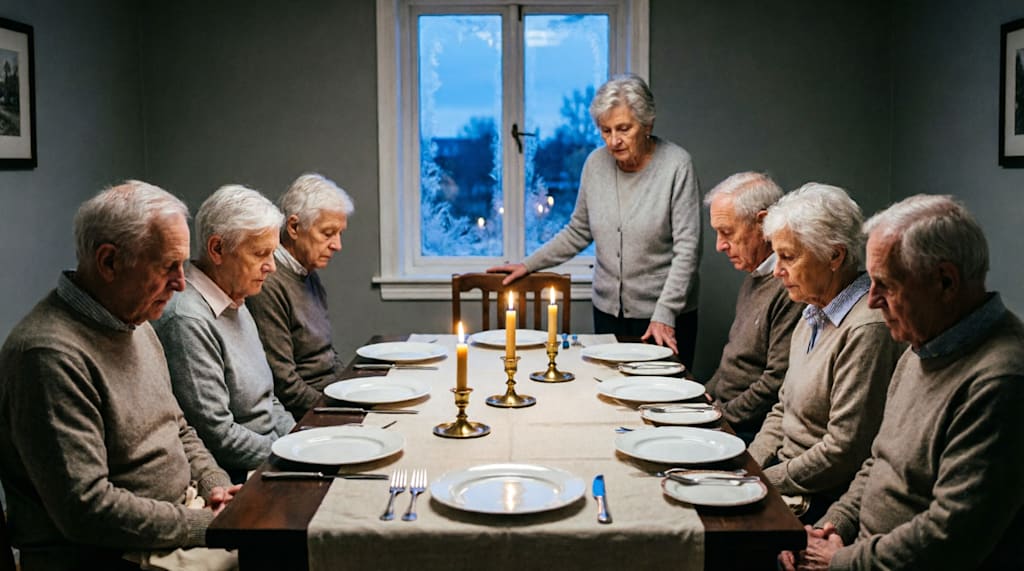
Twelve chairs surrounded the table. Eleven were occupied. One was not.
Twelve plates were set. Eleven held food. One did not.
I reached for the empty plate. My fingers had barely grazed the china when Mrs. Blackwood's hand closed over my wrist. Her grip was gentle but absolute.
"Not that one," she said.
I withdrew my hand. The plate remained. I found a seat three chairs away—the same distance everyone maintained, I would learn, as if proximity to the absence required its own geometry.
No one explained. No one needed to.
Harrow House wasn't a home. It wasn't quite a boarding house either. It existed in that gray space between—the kind of place that appeared in classified ads without photographs, that accepted tenants without references, that asked no questions and expected the same in return.
I'd come here because I had nowhere else to go. The city had become too bright, too loud, too full of corners where memories waited. Harrow House offered shadows. It offered silence. It offered a room on the third floor with a window that faced a brick wall and a lock that still worked.
What it didn't offer was explanation.
The first week, I counted heads. Eleven residents. Twelve plates. I asked Mr. Henderson at breakfast—a thin man who ate toast without butter and read the same newspaper every morning, front to back, as if searching for something that might have changed.
"The empty plate," I said. "Who's it for?"
He folded his newspaper. He looked at me the way you look at someone who's just asked why the sky is blue—not with annoyance, but with the weary patience of someone who's answered this before and knows the answer won't satisfy.
"The twelfth plate," he said.
"That's not an answer."
"It's the only one you'll get."
He stood. He left his plate on the table—clean, polished, nothing wasted. I watched him walk away and understood, finally, that some questions weren't meant to be answered. They were meant to be carried.
By the second week, I'd learned the rhythms:
Arrive at six. Not before. Not after.
Sit three chairs from the empty plate. Not two. Not four.
Don't comment on the untouched china.
Don't move the silverware.
Don't ask who it's for.
Don't be the one who forgets.
I learned that Mrs. Blackwood had run Harrow House for twenty-three years. That Mr. Henderson had been here for fifteen. That the woman in 3B—Miss Clare, though no one used her first name—had arrived the same month as me and learned the rule in a single evening.
I learned that the twelfth plate was washed every night. Dried. Polished. Returned to its place before the bell rang.
I learned that no food ever touched it.
I learned that sometimes, when the light hit the dining room just right, you could see where someone's hands had rested on the table for years—a faint shine on the wood, a worn pattern, a ghost of presence that no amount of polish could erase.
I learned that grief, in this house, was not a wound to be healed. It was a ritual to be honored.
The test came in October, when a young couple moved into 2A. They were loud in the way that only people who haven't yet learned silence can be—laughing in the hallways, playing music after ten, leaving their door open when they cooked so the smell of garlic and onions drifted under other doors like an invitation.
They came to dinner on their third night.
They didn't know.
The woman—Sarah, her name tag said, letters slightly crooked—walked straight to the empty plate and reached for the chair.
The room shifted.
Not dramatically. Not visibly. But I felt it—the way air changes before thunder, the way birds go silent before storm.
Mrs. Blackwood set down her fork.
Mr. Henderson cleared his throat.
No one spoke.
Sarah's husband—David—saw something in their faces that made him pause. He touched his wife's arm. She looked at him. She looked at the table. She looked at eleven faces that had suddenly become strangers.
"This seat..." she began.
"Is taken," Mrs. Blackwood said.
Her voice wasn't cold. It wasn't cruel. It was the voice of someone who'd said these words many times before, who knew that kindness sometimes meant drawing a line and holding it.
Sarah withdrew her hand. She found a seat three chairs away. She didn't ask why. She didn't need to.
They lasted four months.
Then the music stopped. Then the laughter faded. Then the door stayed closed.
No one discussed it. No one needed to.
I started watching the plate after that.
Not in a cruel way. Not in a grieving way. But in the way you watch a clock you know is broken, still checking it anyway, still hoping it might tell time.
Sometimes I'd arrive early and find Mrs. Blackwood polishing the twelfth plate, her movements slow and deliberate, as if the motion itself was a kind of prayer. Sometimes I'd be the one to set it down, my hand hovering over the china, wondering if warmth could transfer through ceramic, if intention could feed a hunger that wasn't physical.
Once, I saw Mr. Henderson standing over the empty place after everyone had left, his palm flat on the table, his eyes closed, his lips moving in words I couldn't hear.
I didn't approach. I didn't ask.
I went to my room and made tea and sat by the window that faced a brick wall and thought about the weight of a plate that no one eats from, and the weight of the people who make sure it stays that way.
The revelation came in December, on the coldest night of the year. Frost patterned the dining room windows. The radiator clanked but didn't warm. Someone had brought soup, and the steam rose in thin ribbons that disappeared before they reached the ceiling.
Mrs. Blackwood arrived late. She never arrived late.
She carried a small envelope, white, no name. She set it beside the twelfth plate, beside the silverware that would never be used.
"Twenty-three years," she said.
The room didn't gasp. Didn't cry. Didn't shift.
But something in the air changed—the way it does when someone speaks a number that's been held in the mouth for years, unspoken, preserved, protected.
Mr. Henderson reached across the table and covered Mrs. Blackwood's hand with his.
No one asked what twenty-three meant.
No one asked why this year mattered and twenty-two hadn't and twenty-four wouldn't.
We ate. We let the soup grow cold. We let the envelope remain unopened. We let the silence do what silence does best: hold what words cannot.
I've lived at Harrow House for eighteen months now. I've attended five hundred and forty dinners. I've polished the twelfth plate forty-seven times. I've watched new residents learn the rule without being told. I've seen them reach for the chair and withdraw. I've seen them ask and be answered with eyes instead of words. I've seen them understand.
Last month, a man moved into 4C. He came to dinner alone. He looked at the twelfth plate for a long time before he sat down—three chairs away, not two, not four, three, which is what everyone does, which is what we all learned, which is part of the rule no one wrote.
After dinner, he approached me in the hallway.
"The plate," he said. "Is it... is it okay if I ask?"
I looked at him. I thought of Mrs. Blackwood's hands. I thought of Mr. Henderson's palm on the wood. I thought of the worn pattern in the table and the plate that stays clean and the silence that feeds something deeper than hunger.
"You can ask," I said.
He waited.
"But we don't answer," I said. "Not because we're hiding. Because some things aren't meant to be known. They're meant to be kept."
He nodded. He understood. He'll be back at six o'clock.
The rule isn't about the plate.
It's about the space around it.
It's about the way eleven people can hold a twelfth presence without naming it. It's about the way grief, when shared, becomes lighter, but when spoken, becomes smaller. It's about the understanding that some losses are not puzzles to be solved but altars to be tended.
We don't eat from the plate because we don't fill the shape of what's missing.
We don't clear it because hunger isn't the point.
We don't ask because the answer lives in the not-asking.
Tonight the bell will ring at six o'clock. I'll arrive at five-fifty-five. I'll polish the twelfth plate. I'll set the silverware. I'll sit three chairs away. I'll watch the light move across the table. I'll notice who arrives late. I'll notice who looks at the plate too long. I'll notice who looks away.
And when the new residents come—and they always come—I'll watch them learn.
I'll watch them reach. I'll watch them pause. I'll watch them understand.
The plate will remain empty.
The silverware will stay polished.
The silence will do its work.
Some rules don't need to be spoken. They need to be kept.
Some plates don't need to be filled. They need to be honored.
Some people don't need to be remembered. They need to be waited for.
We wait.
We don't ask why.
We don't need to.
About the Creator
Edward Smith
I can write on ANYTHING & EVERYTHING from fictional stories,Health,Relationship etc. Need my service, email [email protected] to YOUTUBE Channels https://tinyurl.com/3xy9a7w3 and my Relationship https://tinyurl.com/28kpen3k
Keep reading
More stories from Edward Smith and writers in Fiction and other communities.
The Porcelain Protocol
The morning toast was slightly burnt, but Elias didn’t mention it. He couldn’t. To complain about the toast would require looking at the person who made it, and looking at Clara this morning was an exercise in extreme discipline.
By Edward Smithabout 2 hours ago in Fiction
Perfect people on perfect social media pages.
Restaurant “N”. A week in advance, I reserve a table at one of the most popular restaurants in the city. I spend days preparing for the evening, imagining the atmosphere — elegant interiors, expensive details, a table overlooking the city at sunset.
By Eliza Woodstorm3 days ago in Fiction
The Road by Cormac McCarthy:
"If he is not the word of God, God never spoke." It's a line spoken by The Man, unnamed, early on in the 2007 Pulitzer Prize winning novel, "The Road" by Cormac McCarthy. It's this line, elegiac and moving, infused with despair and hope, that informs you, you're not reading something you'll easily forget.
By Adam Diehl5 days ago in Critique



Comments
There are no comments for this story
Be the first to respond and start the conversation.