
An empire born from betrayal
Instead of helping liberate the Ukrainian Cossacks, the Muscovites enslaved them.
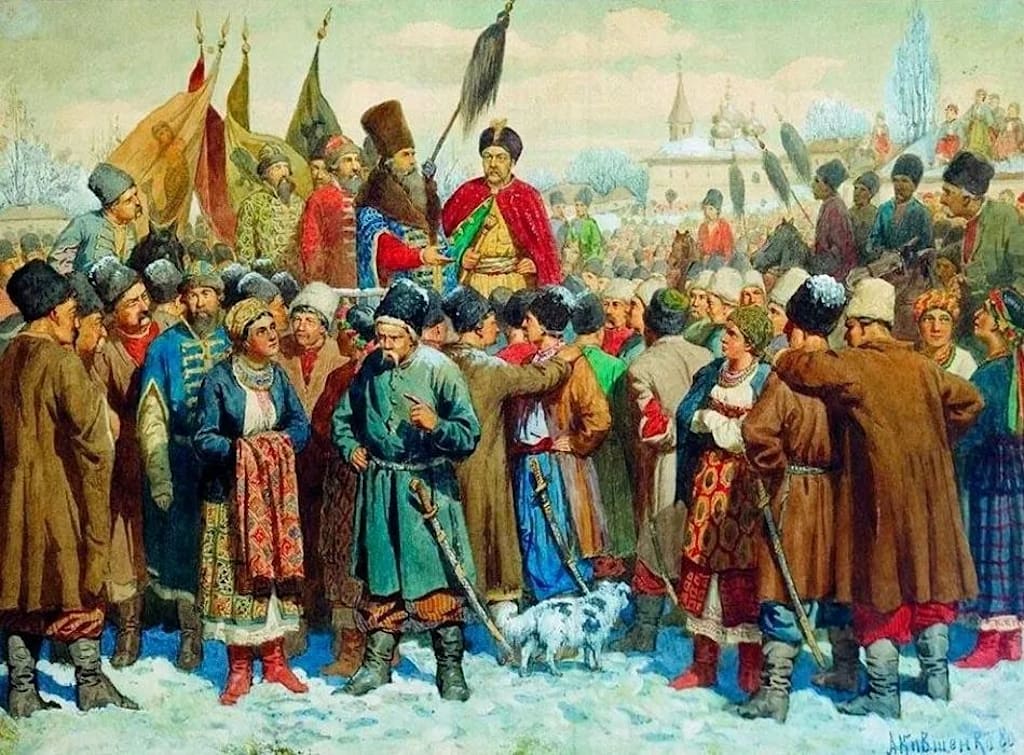
In addressing the motives of the ongoing Russo-Ukrainian war, it is important to know the roots of relationships between Moscow and Kyiv. Here’s a chronicle of the failed Cossack-Muscovite alliance that split Ukraine for centuries and forged Greater Russia.
More than 370 years ago, the Ukrainian Cossacks of Zaporizhia sought help from their eastern neighbors in a war against the Poles. What they received instead was subjugation. The alliance they formed with the Moscow Tsar turned into a “permanent union,” and Ukrainians were subsequently rebranded as “Malorossy” — or “Little Russians.”
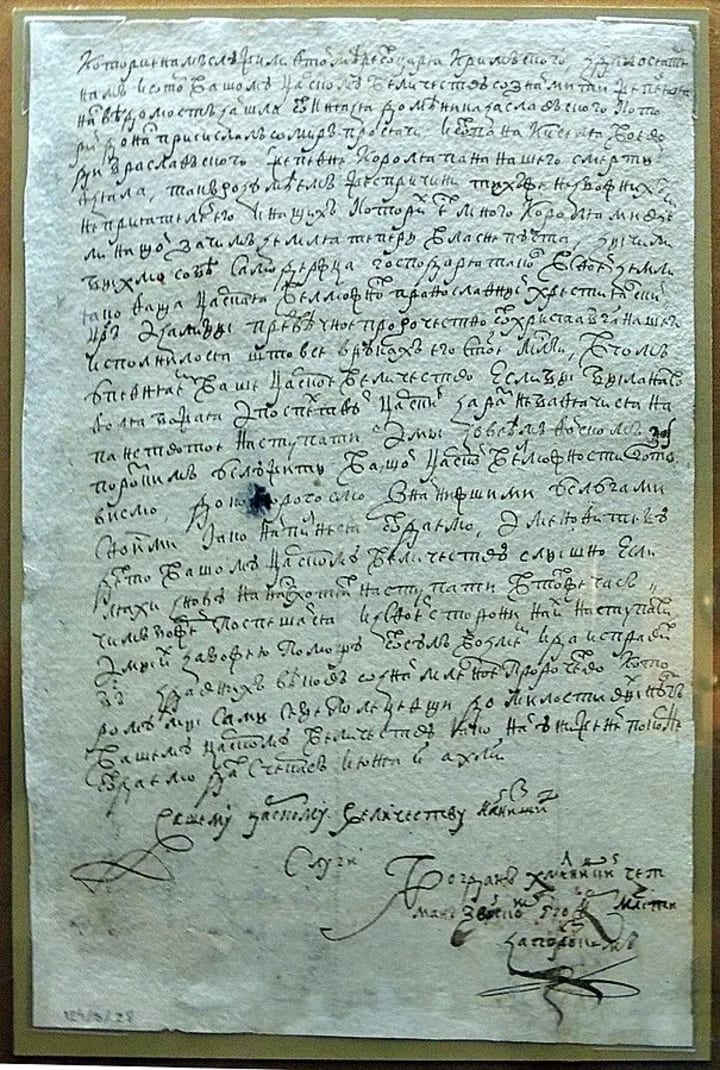
Tsarist historiography later justified the annexation of territories inhabited by Ukrainians — who formed the majority of the Kievan Rus, a Viking-ruled early medieval state in the heart of Europe — through the act of union signed on 18 January 1654, in Pereyaslav, then a city within the Polish-Lithuanian Commonwealth.
Since then, both Soviet and modern Russian historians have consistently portrayed the event as a “reunification” of the Great Russian and Little Russian peoples — a notion historically inaccurate, as the Russian nation itself did not yet exist until the 17th century.
Thus, 1654 became a cornerstone in the creation of the Russian Empire, where Ukrainians and other conquered peoples were seen as “younger brothers,” but in reality reduced to the status of subjects enslaved by the Muscovite elite, much like peasants in Moscow’s own territories.
But what really happened in the winter of 1653–1654? And why do Ukrainians and Russians still see this episode so differently?
Anti-Polish rebellion
At that time, most of the former Kievan Rus lands were under the control of the Polish-Lithuanian Commonwealth (Rzeczpospolita) — a vast, elective monarchy encompassing today’s Belarus, Ukraine, Poland, and the Baltic states.
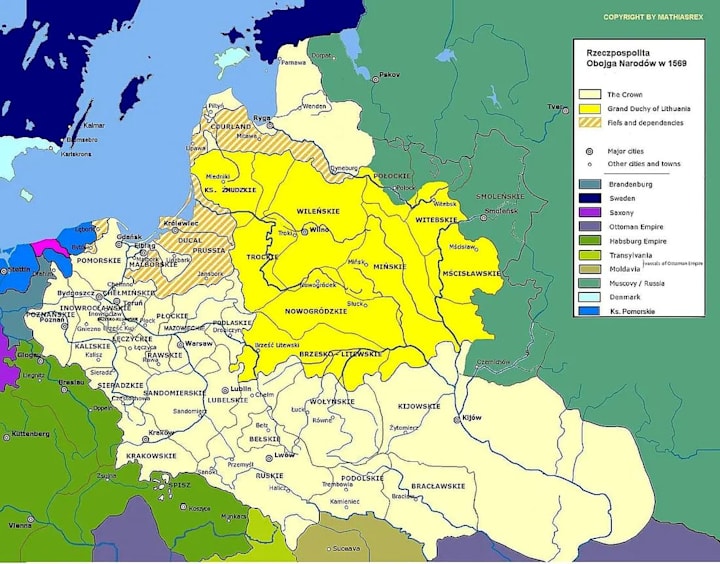
The participation of nations other than Poles and Lithuanians in governance was minimal, as political autonomy was monopolized by the privileged nobility. In this context, Ukrainian hetman (warlord) Bogdan-Zinoviy Khmelnytsky united most Ukrainian Cossacks and mobilized Tatar troops from Crimea, launching a rebellion against the Commonwealth in 1648.
The Hetmanate — a newly-declared Cossack state — was formally independent from the Zaporozhian Sich (Host), yet too weak to stand alone against the Polish-Lithuanian army. Seeking survival, the Cossacks convened the Rada (Grand Council) to approve a military alliance with the Tsardom of Moscow as equal political partners.
At that time, four major powers contested the Hetmanate’s allegiance: the Commonwealth, against which the Cossacks had rebelled; the Ottoman Empire, alien to them in both religion and culture; the Crimean Khanate, a frequent adversary; and the Tsardom of Moscow or Muscovy, which shared their Orthodox faith and claimed common roots in Kievan Rus.
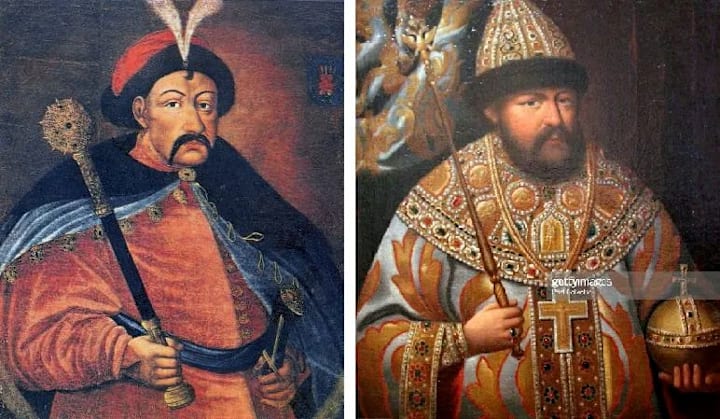
Khmelnytsky chose Moscow, hoping that an alliance with the Tsar would secure either Cossack independence or, at the very least, autonomy within the Polish-led Commonwealth. For this, some historians in Kyiv later accused him of betraying Ukrainian interests, while Russian historians glorified him as a hero.
Given the era’s complex geopolitics, Khmelnytsky’s legacy remains deeply contested even today.
Oaths of allegiance
Historians still debate what were the actual terms of the Pereyaslav agreement. Medieval records diverge sharply, depending on the source.
The Ukrainian version: According to the accords between Bogdan Khmelnytsky and Tsar Alexey Mikhailovich — the second Romanov monarch — the Muscovites established a protectorate over an autonomous Cossack state, offering military aid against Poland-Lithuania.
The Cossacks would swear allegiance to the Tsar, while the Tsar’s envoys were likewise expected to swear allegiance to the hetman. The Zaporozhian Sich (Hetmanate) was thus to remain independent under Moscow’s sovereignty, preserving its freedoms and internal governance.
The Russian version: Khmelnytsky led an uprising of “Little Russians” (Ukrainians) against Polish-Lithuanian oppression for the “reunification” with the “Greater Russians.” The Pereyaslav Rada, according to Moscow, proclaimed the creation of a state union, and the Cossack territories became part of the Tsardom.
Modern Russian historians neglect by large the fact that “Russians” did not exist at that time. It was Tzar Peter I the Great who baptized the former Ugro-Finnish and Moksha tribes — who still spoke different languages — as Russians, renaming his new empire as “Rossiya”, a lexical connection with Kievan Rus.
On 18 January 1654, after alternating victories and defeats against the Poles, the Zaporozhian Sich received the Tsar’s envoys in Pereyaslav. Many Cossacks were absent, still fighting elsewhere, while some commanders openly protested the alliance. Of those present, nearly 300 — a minority — swore allegiance to the Tsar, in a purely oral ceremony with no written treaty.
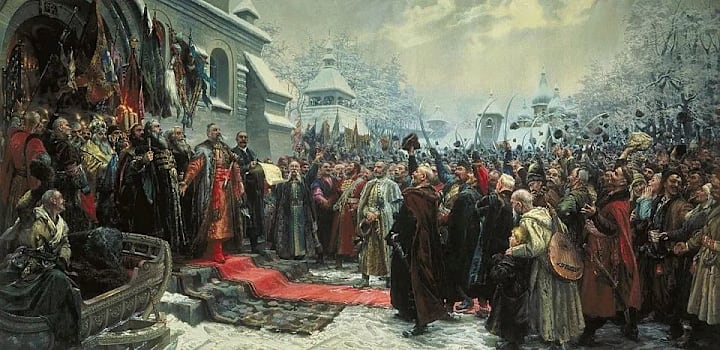
The Tsar’s envoy Vasily Buturlin, however, refused to swear allegiance to the hetman, declaring that Khmelnytsky “did not have the status of a monarch” and that “it is not customary to swear allegiance to subjects.” Enraged, many Cossacks left in protest. Those who remained rationalized their submission as a temporary necessity — believing they could later escape Moscow’s control as they had escaped Polish rule.
Meanwhile, Muscovite officials forced allegiance from local populations, traveling to some 120 settlements to ensure obedience. Peasants and women were excluded, while armed guards compelled Cossacks and townsfolk to swear loyalty.
Even the Orthodox Church, then under the Patriarchate of Constantinople, largely opposed the oath, according to most clerical accounts.
Ukraine’s break from Poland — and fall to Moscow
A part of Cossack commanders defected over this issue. Ukrainian writer Nikolai Gogol later immortalized such “betrayal” in his novel Taras Bulba, where love between a brave Cossack and a Polish noble beauty eclipses loyalty to Moscow.
Militarily, the Tsar honored his pledge and fought alongside the Cossacks against the Commonwealth for 13 years — though not for their independence, but to expand Moscow’s frontiers, paving the way for the Russian Empire less than a century later.
The war split Ukraine in two: Moscow annexed the eastern half, granting limited autonomy that it later revoked. The hetman was forbidden from foreign diplomacy or independent campaigns, and within a century, Ukrainian peasants were reduced to serfdom, equal to Muscovite peasants.
Thus, Eastern Ukraine escaped Polish domination only to fall under Muscovite rule, where Russification policies put enormous pressure on its language, culture, and national identity.
The Cossack-Muscovy alliance did not immediately entail full incorporation of the Zaporozhian Sich into Moscow’s state, but tensions soon resurfaced. The Cossacks rebelled periodically against the Tsar, launching raids into Russian borderlands such as Kursk and Belgorod. Notably, Ivan Bohun, a Cossack leader, continued to strike Muscovite settlements in defiance.
The Tsar’s betrayal
In 1656, Tsar Alexey Mikhailovich signed the Treaty of Vilna with the Polish-Lithuanian Commonwealth, effectively abandoning his Cossack allies. Feeling betrayed, the Cossacks were left to fight alone.
They sought new allies — Moldovans, Transylvanians, Swedes, and Tatars — to defend their autonomy. After Khmelnytsky’s death, under hetman Ivan Vygovsky, these simmering tensions with Moscow erupted into open conflict.
A turning point for Eastern Europe
History offers no clear answer to what might have happened had the Commonwealth granted the Cossacks autonomy, or if Khmelnytsky had chosen differently. He may not have been a traitor after all — only a leader who gambled on the wrong ally.
What is certain is that his decision reshaped Eastern Europe for ever. The once-peripheral state of Moscow emerged, within 67 years, as an empire — built on the subjugation of eastern Ukrainians and other neighbors, and on the theft of Kievan Rus’s heritage, which it appropriated to call itself the Russian Empire.
The Pereyaslav Rada of 1654 marked only the beginning of a long process: the westward expansion of Muscovy, the gradual occupation and assimilation of the Hetmanate, and the eventual decline of the Polish-Lithuanian confederation. In fact, the Cossack split from Rzeczpospolita accelerated its disintegration.
In the following century, the Zaporozhian Sich was destroyed, the Hetmanate dismantled, and even the Tatar Crimea fell under Moscow’s control.
The alliance that began as a plea for protection ultimately forged the chains of empire — and changed the destiny of Eastern Europe forever. Moscow’s rise from a regional principality to a European empire began not through conquest alone, but through the manipulation of its closest kin.
Today, Russia is seeking once again to restore that lost empire — again, at the expense of Ukraine, using the same narratives of “shared history” and “fraternal unity” that justified its domination centuries ago.
The tragedy of Pereyaslav still echoes in the present war: Ukraine’s fight for sovereignty is, once more, a struggle to escape the empire it unwillingly helped create.
And here’s an interesting detail of this story: the original Pereyaslav Agreement document has never been found, and most scholars believe it never actually existed as a formal written treaty in the first place.
When Kyiv asks Moscow to show it, the latter refers to a heavily-modified, Tsar-approved version that is now preserved in the Russian State Archive of Ancient Acts in Moscow.
Sources: HistPol, Free Europe, NovayaGazeta, Pustunchik, Wikipedia and a dozen other publications.
***
This story was first published on my blog NewsCafe and on Medium. Please notify me of broken links.
You may support my writing effort via BuyMeCoffee. Any amount is welcome.
About the Creator
Keep reading
More stories from Aurel Stratan and writers in History and other communities.
One of Ancient Greece’s most sacred sanctuaries was found by chance
Eretria, an influential city-state of Ancient Greece, was the host to one of the most renowned religious sites of the old Greek world — the Temple of Artemis Amarysia. Built before the 3rd century B.C., the sanctuary became the destination of mass marches by Eretrians every spring.
By Aurel Stratanabout 12 hours ago in History
The Day the Giant Stopped Moving
The Day the Giant Stopped Moving For nearly a century, the United States stood as the world's most dominant power — economically, militarily, and culturally. From shaping global trade to leading wars and alliances, America was not just a country; it was the engine of the modern world. But today, many analysts, policymakers, and observers are beginning to ask a serious question: Is America no longer leading the world the way it once did?
By Wings of Time 5 days ago in History
Something Is Beginning, I Think Challenge Winners
This challenge wasn’t about clean starts. It was about that weird in-between where something is beginning, but no one really knows what yet. A lot of these stories leaned into hesitation, into pauses and false starts and that feeling that something is about to happen but hasn’t quite.
By Vocal Curation Team4 days ago in Resources


Comments
There are no comments for this story
Be the first to respond and start the conversation.