
The Vanishing Civilization
Archaeologists and historians uncover the clues behind one of history’s most baffling disappearances—and what it reveals about human survival

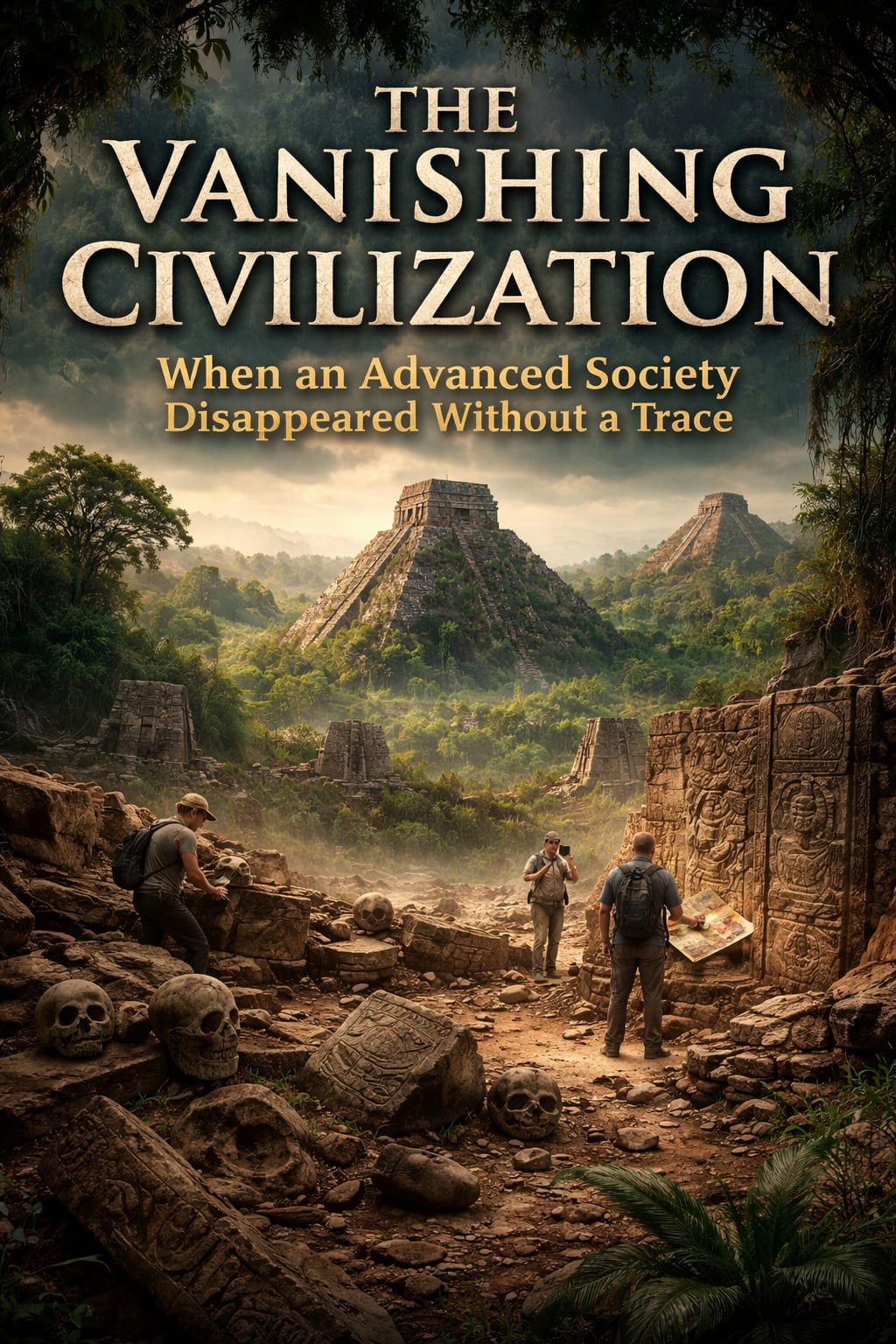
Throughout human history, civilizations have risen, flourished, and eventually declined. Yet some disappearances are so sudden and mysterious that they continue to puzzle experts for centuries. One such case is that of a thriving society that seemed to vanish almost overnight, leaving behind silent cities, abandoned homes, and unanswered questions.
Among the most famous examples is the ancient Maya civilization, which once dominated large parts of present-day Mexico and Central America. At its peak between 250 and 900 CE, the Maya built magnificent cities like Tikal and Copán, complete with towering pyramids, intricate temples, and advanced systems of writing, mathematics, and astronomy. Their achievements rivaled those of any ancient culture. And then, something strange happened.
By the end of the 9th century, many of these cities were abandoned. There was no single catastrophic event recorded—no massive battle scars, no widespread destruction by invaders. Instead, the cities were simply left behind, reclaimed slowly by the jungle. The people did not vanish entirely, but the societal structure that once supported millions collapsed dramatically.
For decades, historians debated what could have caused such a decline. Early theories pointed to warfare or foreign invasion. However, modern research paints a more complex picture. Evidence now suggests that environmental stress played a major role. Prolonged droughts, confirmed by sediment cores and cave formations, likely strained agricultural systems. The Maya relied heavily on predictable rainfall, and when it failed, crops suffered, leading to food shortages and instability.
But climate alone doesn’t tell the full story. Archaeologists have uncovered signs of overpopulation and deforestation. As the population grew, more land was cleared for farming, weakening the ecosystem. Soil became less fertile, and water sources became harder to manage. The combination of environmental degradation and climate change created a perfect storm.
Social and political factors likely worsened the situation. The Maya civilization was not a unified empire but a network of city-states, often competing with one another. During times of crisis, these rivalries may have intensified. Warfare, internal unrest, and loss of trust in leadership could have accelerated the collapse.
Interestingly, the Maya case is not unique. The Indus Valley Civilization, centered in present-day Pakistan and northwest India, also experienced a mysterious decline around 1900 BCE. Cities like Mohenjo-daro and Harappa were among the most advanced of their time, featuring sophisticated urban planning, drainage systems, and trade networks. Yet, like the Maya, they were gradually abandoned.
Recent studies suggest that shifting river patterns and climate change may have disrupted agriculture and trade in the Indus region. As rivers dried up or changed course, settlements became unsustainable. People likely migrated in search of more stable environments, leading to the gradual dissolution of urban life.
What makes these stories so compelling is that they challenge the idea of permanence. These were not primitive societies; they were highly organized, innovative, and resilient. Yet they were still vulnerable to a combination of environmental pressures and human decisions.
Today, historians and scientists are using advanced technologies—such as satellite imaging, climate modeling, and chemical analysis—to piece together these ancient mysteries. Each discovery adds another piece to the puzzle, helping us understand not just how these civilizations fell, but why.
The lessons are strikingly relevant. Modern societies face many of the same challenges: climate change, resource depletion, and political instability. While our technology is far more advanced, the fundamental relationship between humans and the environment remains unchanged.
The disappearance of these ancient societies serves as a powerful reminder. Civilizations do not simply vanish without reason—they unravel through a series of interconnected events. By studying the past, we gain insight into our present and perhaps a warning for our future.
In the end, these vanished worlds are not entirely lost. Their ruins still stand, their stories still echo, and their lessons still endure—waiting for us to listen.
About the Creator
Irshad Abbasi
Ali ibn Abi Talib (RA) said 📚
“Knowledge is better than wealth, because knowledge protects you, while you have to protect wealth.
Keep reading
More stories from Irshad Abbasi and writers in History and other communities.
Who Killed Ramesses III?
For centuries, the death of Pharaoh Ramesses III—one of ancient Egypt’s last great rulers—remained shrouded in mystery. Historians knew he died around 1155 BCE, but whether his death was natural or the result of foul play was unclear. Ancient texts hinted at intrigue, betrayal, and a palace conspiracy, yet definitive proof remained elusive. It wasn’t until the 21st century that science finally uncovered the truth, revealing a chilling tale of assassination at the heart of the royal court.
By Irshad Abbasi about 6 hours ago in History
Corinne Griffith (1894-1979)
By Brian D’Ambrosio Corinne Griffith, born November 21, 1894, in Waco, Texas, became one of the most admired figures of the silent film era, celebrated for her elegance, poise, and expressive subtlety on screen. Known as “The Orchid Lady of the Screen,” Griffith cultivated an image of refinement and emotional restraint that set her apart from her contemporaries. Beneath the Hollywood persona lay a Texas childhood shaped by her Italian ancestry and the civic prominence of her maternal family, whose accomplishments left a lasting impression on her sense of artistry, ambition, and cultural awareness.
By Brian D'Ambrosio 3 days ago in History
5 Battles in History Where Divine Intervention Changed Everything
War has been a part of human history for as long as we can remember. From defending territories to protecting loved ones, humans have always found a reason to fight. While strategy, planning, and leadership often decide the outcome of battles, there are moments when fate or perhaps something greater intervenes to tip the scales. Here are five of history’s most decisive battles that were allegedly won thanks to divine intervention.
By Areeba Umair4 days ago in History


Comments
There are no comments for this story
Be the first to respond and start the conversation.