
The Lungs of the Leviathan
Of Entropy and Chaos

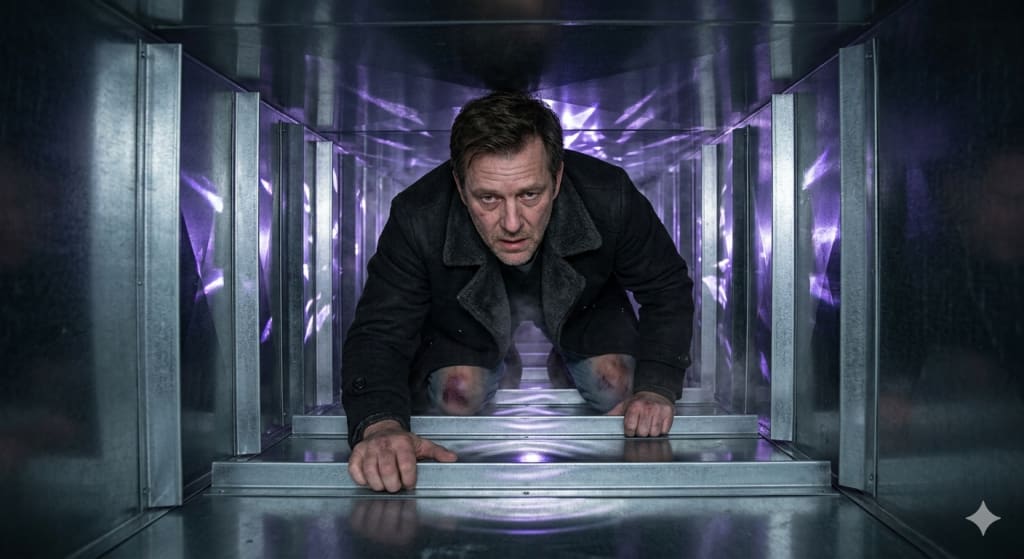
The ventilation shaft of the Aegis Building was a masterclass in sterile, high-pressure engineering. To the world outside, it was a marvel of the "New Century" architecture—a structure that breathed with the rhythmic precision of an athlete. I should know. I had spent three years of my life obsessing over the fluid dynamics of these very ducts. I had patented the "Thorne-Baffles," the series of angled, galvanized steel plates designed to catch the whistle of the wind at eighty stories up and silence it before it could disturb a single CEO’s phone call.
Now, those same baffles were catching on the shoulders of my charcoal-lined coat, the metal screeching against my frame.
I crawled through the lungs of the leviathan, and for the first time, I realized how suffocating my own design really was. The air here was too clean. It lacked the grit of the Alcyone streets, the smell of rain-soaked asphalt and burnt coffee that defined the District of Rust. Here, the air was scrubbed, pressurized, and chilled to a precise sixty-eight degrees. It was "Respiratory Architecture," a term I had coined in a dozen keynote speeches. I told the world that a building should be a living organism that protects its inhabitants. I hadn't mentioned that it also acted as a selective filter, ensuring the elite breathed mountain-peak purity while the "variables" below choked on the exhaust of progress.
Every inch I crawled was penance. The duct was a horizontal throat of polished zinc, reflecting the dim light of my Static-vision in jagged, violet shards. My knees, already bruised from the trek through the industrial wreckage of the shipyards, throbbed with every movement. My breathing was the only sound in the pressurized silence—a ragged, wet noise that seemed to echo for miles down the galvanized line. I was the pathogen in the system. I was the "noise" I had once promised to eliminate.
The "Static" began to change as I bypassed the 40th floor. It was chaotic, a jagged wall of white noise that clawed at the edges of my retinas and made my teeth ache. It was the sound of a city falling apart, the vibration of unrefined misery. It was terrifyingly melodic.
It was a low, sinusoidal hum—a carrier wave that vibrated through the metal beneath my chest. It wasn't a noise so much as a presence, a controlled frequency that felt like a bow being drawn across a cello string made of lead. It was a B-flat sub-harmonic, a tone so deep it didn't enter through the ears; it entered through the solar plexus. This was the "Corporate Static." It was the sound of a well-oiled machine, a rhythmic pulse that kept the heartbeats of the office workers above in a state of suspended, productive anxiety.
I felt the "Gospel of the Grid" crumbling. I had always believed in the 90-degree angle as a form of spiritual truth. I thought that by imposing hard lines and vertical ascent on the skyline, I was bringing a sense of divine order to a messy, curved world. I viewed the city as a problem of geometry that only I could solve. But as I felt that B-flat frequency vibrating my ribcage, I realized the Grid wasn't a service. It was a tuning fork.
I reached a junction where the main respiratory trunk dipped toward the subterranean levels. This wasn't in the public blueprints. The Aegis Building supposedly ended at the P2 parking level, resting on a foundation of reinforced basalt. But as I navigated the vertical drop of the service shaft, sliding down the pressurized baffles like a coin in a slot, the Static flared from violet to a deep, bruising indigo.
I was descending into the "Ghost-Geometry"—the spaces between the lines.
My patents for the ventilation system hadn't included the "Acoustic Dampeners" I was seeing now. These weren't made of steel or fiberglass. They were heavy, lead-lined cylinders etched with recursive patterns that defied standard architectural logic. They looked like something pulled from a medieval grimoire and translated into industrial mass. They weren't designed to move air; they were designed to compress sound. They were "Inhibitors," meant to trap the screams of the city before they could reach the surface.
I realized then that my arrogance had been my blindness. I had thought the Vane Foundation hired me because I was a visionary. They hadn't. They hired me because I was a "Master of Cages." They needed someone who could build a structure so perfect, so rigid, that the inhabitants wouldn't even realize they were being harvested. My "Gospel" was the instruction manual for their psychic abattoir.
The temperature dropped as I reached the lowest level. The air here wasn't just cold; it was heavy, as if the atmospheric pressure had been doubled. My vision began to strobe. The purple lines of the Static weaved through the air itself, forming a lattice of geometric energy that pulsed in time with that subterranean B-flat.
Through the floor of the duct, I felt a new vibration. It wasn't the mechanical hum of the HVAC system. It was vocalization. A deep, guttural chanting that seemed to emerge from the stone of the building’s foundation.
I was close to Boardroom B. The blueprints called it a "Mechanical Storage" room, a mundane box of concrete and wires. But as I crawled toward the vent cover at the end of the line, the smell reached me—the scent of ozone, old copper, and something sweet and cloying, like lilies rotting in a pressurized tomb.
I gripped the edge of the vent cover, my fingers trembling. The metal was cold, vibrating with a frequency that made my fingernails feel like they were being pulled from the beds. I looked through the slats, and for the first time in my life, the "Architect of the New Century" saw a structure he couldn't explain.
Beneath me, the world of the Grid ended, and the Liturgy of the Blade began.
I pressed my face against the cold, vibrating slats of the vent, the metal smelling of ozone and the metallic tang of unwashed copper. Below me, the mundane reality of "Mechanical Storage 4" had been stripped away like a coat of cheap paint, revealing a skeletal, terrifying truth.
To the naked eye—this would have looked like an avant-garde boardroom. But my retinas had been rewired by the fall from the Blackwood Bridge. Through the shimmering violet haze of my Static-vision, the room didn't possess walls so much as it possessed "tensions."
The space was a masterpiece of Ghost-Geometry.
Every corner of the room was etched with hair-thin, glowing lines of gold and deep purple that pulsed with the regularity of a heartbeat. These weren't decorative; they were functional. I recognized the patterns—recursive fractals I had once toyed with in my graduate thesis on resonant structural integrity, but here they were taken to a grotesque extreme. The lines traced the path of every vibrational wave in the building, catching the ambient noise of three thousand workers and funneling it downward. It was a massive harmonic resonator, a lens made of architecture designed to focus the "Atmospheric Tension" of the city into a single, needle-sharp point.
In the center of the room sat the obsidian table. It was a circular slab of volcanic glass so dark it sucked the candlelight into its depths. To my eyes, it wasn't solid; it was a grounding plate, a black sun at the center of webbed energetic filaments. The floor beneath it wasn't concrete but a series of interlocking bronze gears and lead-lined troughs, currently silent but humming with potential kinetic energy.
The chanting began.
It didn't start as a sound, but as a pressure in my sinuses. A deep, guttural Gregorian drone emerged from the hidden speakers I had once installed to provide "ambient executive focus." Now, they were broadcasting a sub-aural frequency, a pitch so low it bypassed the eardrum and vibrated the fluid in my inner ear. It was a dirge for the living, a slow, rhythmic sequence that felt like a heavy stone being dragged over silk.
The doors at the far end of the chamber—reinforced steel doors I had designed to be soundproof—slid open with a hiss of pneumatic breath.
Twelve figures entered the chamber in a slow, choreographed march. They moved with a synchronized, heavy-footed gait that matched the tempo of the sub-harmonic chant.
Six of them were the Foundation. I recognized them instantly, even in the dim, bruised light. These were the titans of industry, the gray-suited men and women whose names were etched into the cornerstones of the city’s banks. They wore their bespoke charcoal suits, but draped over their shoulders were stoles of heavy crimson silk, embroidered with the symbol of the Broken Compass—the sigil of those who believe the world must be lost before it can be measured. The head figure was a man, I knew to be Julian Vane, the head of the Vane Foundation, and the brother of Elena Vane. I had never actually met him in person. He was the executor of Elena’s Estate as well.
The other six were the Order. They were the Architects of the Scythe, the true masters of the Grid. They wore robes of heavy, light-drinking wool that seemed to absorb the flickering orange glow of the tallow candles scattered around the room. Their hoods were pulled low, but as they reached the obsidian table, they pushed them back.
Their faces weren't quite human. It wasn't that they were monstrous; it was that they were wrong. Their features didn't align with the natural symmetry of the skull. They looked like blueprints that had been folded too many times, a glitching overlap of bone, shadow, and something that looked like static-rendered flesh. One man had eyes that seemed to sit on different horizontal planes; another’s jawline appeared to vibrate even when he was silent. They were the physical manifestation of the frequencies they served—beings who had sacrificed their own structural integrity to become better conductors of the Scythe.
They formed a perfect circle around the obsidian table. They did not sit. In this room, there was no hierarchy of comfort—only the hierarchy of the Harvest.
The air in the chamber grew heavy, the scent of rotting lilies and scorched hair intensifying as the tallow candles sputtered. The Gregorian chant shifted, moving from a monotone drone into a dissonant minor key that made the very air feel jagged.
Julian led the chant, "Mensor. Factor. Caelator. Falx," which was whispered in unison, their voices a mixture of gravel and glass. The Measurer. The Maker. The Carver. The Scythe.
Marcus arrived last. He entered through a hidden panel in the rear wall, his movements sluggish as if he were carrying a physical weight upon his shoulders. He looked exhausted, his skin the color of wet cement, his eyes sunken into deep, skeletal hollows. Yet, as he approached the head of the table, his posture straightened, fueled by a feverish, religious intensity that seemed to radiate from him like heat from a furnace.
Julian carried a silver thurible—a vessel I had never seen. It was an intricate, geometric cage of filigreed wire, and the smoke that drifted from it was thick and oily. He began to swing it in a wide, slow arc over the obsidian plate. The smoke didn't rise; it fell. It clung to the surface of the black glass, swirling into the etched grooves of the recursive fractals I had seen earlier.
"We are the surveyors of the void," Julian intoned, his voice amplified by the room’s occult acoustics until it sounded like a thunderclap inside my skull. "We are the stabilizers of the entropic flow. The city is a garden of noise, and we are the pruning shears."
The Foundation members bowed their heads, their crimson stoles shimmering. The Order members leaned forward, their glitching faces illuminated by the orange fire.
The atmospheric pressure in the room climbed. My vision began to strobe, the violet lines of the Static pulsing in time with Marcus’s rhythmic swinging of the thurible. Every swing sent a new wave of B-flat sub-harmonic through the floor, a vibration that made the metal of the vent beneath me feel like it was turning to liquid.
I realized then that this wasn't just a meeting. It was a calibration. They were tuning the building, and by extension, they were tuning the city. They were preparing the instrument for a performance that would require thousands of lives to sustain.
Julian stopped the thurible. The smoke on the table began to glow with a sickly, bruised light.
"The time of the Honed Ashlar is upon us," he whispered, his voice dripping with a terrifying reverence. "The first Harvest is complete. Now, we look to the result."
He tapped the center of the obsidian table, and the "Ghost-Geometry" of the room responded. The floor gears began to turn with a low, tectonic grind, and the holographic heart of the beast began to beat.
The grinding of the floor gears subsided, replaced by a sound that made the hair on my arms stand up—a high-pitched, crystalline whine that cut through the low Gregorian drone like a razor through silk.
Julian pressed his palms flat against the obsidian table. The recursive fractals etched into the stone began to bleed a pale, sickly violet light. The smoke from the thurible, which had settled into the grooves, was suddenly galvanized. It rose in a swirling column, twisting and knitting itself together until a shimmering, three-dimensional image hovered above the black glass.
It was the Blackwood Bridge.
My heart hammered against my ribs, a frantic, irregular rhythm that threatened to give me away. I knew every bolt, every suspension cable, every structural load of that bridge. I had birthed it. But this projection wasn't the architectural model I had lived with for years. It was rendered in the "Static"—a translucent, vibrating map of energy.
"Observe the primary conductor," Marcus whispered, his voice trembling with a terrifying reverence.
The hologram shifted. I saw the bus—the one filled with nurses, students, and tired commuters heading home in the rain. In the "Static" view, they weren't people; they were bundles of flickering amber light, heat signatures of soul and consciousness. As the bridge began its engineered "collapse," the amber light turned a violent, jagged violet.
I watched the moment of the fall. As the pavement gave way and the bus plummeted toward the black water of the Styx, the violet light erupted. It didn't just dissipate; it was pulled. The holographic pylons of the bridge—my pylons—acted like massive, invisible magnets. They caught the spray of raw terror and grief, spiraling it down into the foundation of the bridge where it was compressed into a dense, glowing orb of pure entropic energy.
Julian, hissed "the yield of the Blackwood event was a tidal wave of distilled Grief," the High Architect of the Order announced. His voice was cold, devoid of any human empathy, sounding like the crunch of dry bone.
A Councilman, the man whose hands I had shaken at a dozen charity galas, stepped closer to the light. The violet glow cast deep, demonic shadows across his face. "Is it enough?," he murmured, his voice thick with greed. "Is it enough to stabilize the North Quadrant’s financial markets for a fiscal year? The cost, Julian... the media is already calling it a structural massacre. My office is being flooded with demands for an independent inquiry."
Julian turned his glitching, asymmetrical face toward the Councilman. "You speak of 'cost' as if you are still balancing a ledger of gold Councilman. You must think in terms of the Garden."
"The Garden?" the Councilman spat. "People are dead. Families are erased."
"Exactly," Julian rasped. "A garden is not a place of infinite growth; it is a place of managed life. If the gardener does not prune the weak stems, the sun cannot reach the elite blooms. Entropy is the rot that threatens the system. Every 'variable'—the homeless, the dreamers, the ones who do not fit the Grid—they create noise. They create chaos. They drain the Stability of the city."
He gestured to the glowing orb in the hologram. "We do not 'kill,' Councilman. We harvest. We take the raw, entropic energy of their tragedy and we tune it. We compress it. We turn their final, desperate realization of mortality into the very frequency that keeps your banks running, your satellites in orbit, and your citizens compliant in their cubicles."
Marcus stepped forward, his eyes burning with the light of the violet orb. "The city is a closed system, Councilman. Energy cannot be created or destroyed, only transformed. We are the transformers. We are the only thing standing between Alcyone and total disorder."
I felt a cold sweat break across my brow. The "Architecture of the Scythe." They were using my buildings—my life’s work—as the machinery for this conversion. The "Gospel of the Grid" wasn't a philosophy of order; it was a blueprint for a psychic abattoir. Every perfect 90-degree angle I had labored over was a sharpening stone for their blade. I had built the "Thorne-Baffles" not to silence the wind, but to trap the frequencies of the dying.
The Senator looked at the map of Alcyone that Marcus now projected. It was a grid of shimmering nodes, each one corresponding to a building I had designed. The Aegis Building, the Vane Tower, the Blackwood Bridge—they were all connected by glowing lines of "Static" energy.
"And the final phase?" the Senator asked, his voice wavering between fear and fascination. "The Honed Ashlar?"
"The Honed Ashlar is the ultimate capacitor," Julian explained, his fingers tracing the vertical line of the Aegis Building. "It is the stone that will anchor the Grand Harvest. The entire city becomes a perpetual motion machine of tragedy and stability. Every heartbeat in the city tuned to the Scythe. We will achieve a state of permanent, perfect order."
"But it requires a Keystone," Marcus added, his eyes narrowing. "A frequency of such purity and resonance that it can bind the Ashlar to the Grid forever."
The chanting in the room intensified, the voices of the Order rising in a dissonant, screeching crescendo that made the metal of the vent beneath me vibrate with a violent, stinging heat.
"Keystone. Keystone. Keystone," they whispered.
The realization hit me with the force of a structural collapse. They weren't just talking about a stone or a piece of technology. They were talking about a person. They were talking about a frequency that had survived the impossible—a "variable" that had been "transformed" by the very machine they had built.
I looked at the hologram of the bridge again. I saw the violet energy being pulled toward the pylons, but then I saw a tiny, jagged spark of white light that didn't follow the path. It was a "glitch" in the math. It was a spark that had fallen and refused to go out.
I was the Keystone.
My hands began to shake so violently that I had to pull them back from the vent cover to keep them from clattering against the metal. I wasn't just a pathogen in their lungs. I was the final component of their nightmare. They didn't just want me dead; they wanted to harvest the very essence of my survival to power their eternal city-wide cage.
Julian looked up, his gaze sweeping across the ceiling. For a second, the orange candlelight caught the whites of his eyes, and I could have sworn he smiled.
"The Harvest is coming," he whispered to the empty air. "And the Architect is already here."
The silence that followed the word "Keystone" was more deafening than the Gregorian chant. It was a pressurized, expectant silence, the kind that precedes a structural failure. In the boardroom below, the violet light from the holographic bridge pulsed with a slow, sickly rhythm, casting the distorted shadows of the Order against the walls like the flickering limbs of insects.
Julian leaned over the obsidian table, his hands splayed wide. "Silas Thorne was the greatest builder of cages I ever knew," he said, his voice dropping to a jagged whisper that carried up the ventilation shaft and settled in my ears like ash. "He believed in the Grid with a fervor that bordered on the divine. He thought he was creating a sanctuary of logic. But he was too arrogant to realize that every cage needs a bird, and every bird eventually needs to sing."
A woman from the Foundation, a developer whose high-rises had blighted the Alcyone waterfront for a decade, stepped forward. Her voice was sharp, a contrast to the low drone of the room. "You said he was dead, Julian. The fall from the Blackwood pylon was a three-hundred-foot drop into a high-velocity current. No one survives that."
"He didn't survive," Julian interjected. He turned his head, and in the Static-vision, I saw his features ripple—one eye sliding lower than the other for a split second before snapping back into place. "He was transformed. The impact didn't break him; it tuned him. When the pylon collapsed, Silas Thorne was at the exact focal point of the Harvest. He absorbed the initial burst of entropic energy. He is currently vibrating at a frequency we haven't yet mastered—a frequency of survival that defies standard math."
Marcus nodded, his eyes fixed on the map of the city. "He is a 'glitch' in the math. His very existence creates resonance that interferes. If he remains at large, he becomes a variable that could shatter the entire Grid. But if he is captured... if his frequency is harvested and seated..."
"Then the math becomes absolute," Julian finished.
I felt a coldness spread through my chest that had nothing to do with the sixty-eight-degree air of the vents. They didn't just want my life. They wanted my physics. They wanted to take the man who redrew the skyline and turn him into the eternal battery for a city-wide nightmare.
The realization hit me with the weight of a thousand tons of reinforced concrete: my "Gospel of the Grid" had been the set of instructions for my own crucifixion. I had spent my life perfecting the cage, only to find out I was the only bird with the right song to keep the bars from rusting. Every line I had drafted, every load-bearing wall I had calculated, was a part of the Scythe. My life’s work was a psychic abattoir, and I was the master butcher who had accidentally stepped onto the hook.
"Find him," Julian commanded.
Detective Miller, silent to this point, spoke coldly, "The recovery teams are already sweeping the District of Rust. Silas always had a sentimental streak for his own failures. He will return to the wreckage. He will seek out the places of his past.”
Marcus straightened his back, a sickeningly familiar smile touching his cement-colored lips. "The Aegis Building is ready. The respiratory systems are tuned. The Honed Ashlar is waiting. Once Silas is seated at the apex, we drop the blade."
He gestured toward the hologram of the building I was currently hiding in. To the normal eye, the Aegis Building was a shimmering spire of glass. But through the Static, the skyscraper didn't look like an office building anymore. It was a giant, vertical blade, its sharpened edge poised over the neck of the city. The "Thorne-Baffles" I had designed weren't meant to quiet the wind; they were the teeth of the saw, designed to vibrate at the frequency of the Culling.
"The Grand Harvest begins at midnight on the equinox," Julian announced. "Until then, we maintain the frequency. Mensor. Factor. Caelator. Falx."
The twelve figures joined in the final chant, their voices rising into a deafening, dissonant wall of sound. The obsidian table began to vibrate so violently that the smoke from the thurible turned into a whirlwind of violet sparks.
I had to get out.
I backed away from the vent, the metal creaking under my weight like a groan of structural fatigue. I moved with a frantic, desperate energy, my knees scraping against the galvanized steel of the duct. Every sound I made felt like a thunderclap in the pressurized silence of the respiratory system. I scrambled back through the "Lungs of the Leviathan," but the air now felt thick and oily, as if the building itself were trying to drown me in its own filtered purity.
As I reached the vertical drop-off, the Static in my vision flared white. The B-flat sub-harmonic that had been a low hum was now a rhythmic pounding, a tectonic heartbeat that seemed to pulse from the very foundations of the tower. The building was alive. It was hungry. And it knew I was inside its throat.
I slid down the pressurized baffles, my charcoal coat tearing on the sharp edges of my own patents. I was a man falling through his own legacy, and every floor I passed was a floor I had lied about. I wasn't an architect. I was a conspirator in a slow-motion massacre.
I reached the exit hatch in the service alley, kicking the heavy steel plate open with a force that sent a jolt of agony through my hip. I tumbled out into the Alcyone rain, the cold, wet grit of the District of Rust hitting me like a benediction.
I stood there for a moment, drenched and gasping, the scent of ozone and rotting lilies still clinging to my skin. I looked back up at the Aegis Building. Through the falling rain and the shimmering violet haze of my rewired retinas, the tower loomed over the city like a giant, silent executioner. It was a monument to verticality and silence, a vertical blade waiting for the signal to drop.
The "Theory of the Culling" wasn't just a philosophy; it was a deadline. The Grand Harvest was coming, and I was the only one who knew the math of the blade.
I had spent my life building cages, but tonight, I had learned how to be the earthquake.
I turned my back on the shimmering spires and walked deeper into the rust, the low vibration of the city’s misery finally matching the rhythm of my own heart. It was time to find the "variables." It was time to turn the volume up until the glass shattered.
About the Creator
Nathan McAllister
I create content in the written form and musically as well. I like topics ranging from philosophy, music, cooking and travel. I hope to incorporate some of my music compositions into my writing compositions in this venue.
Cheers,
Nathan
Keep reading
More stories from Nathan McAllister and writers in Horror and other communities.
Of Entropy and Chaos
As the frequency from the tape filled the office, the city outside the 42nd-floor windows underwent a terrifying, high-definition transformation. The "Static" didn't just swirl in chaotic clouds anymore; it organized. It snapped into a rigid, mathematical lattice that mirrored the steel skeletons of the skyscrapers below.
By Nathan McAllister7 days ago in Horror
The Doll Maker
Funeral dolls are normally used at a wake. Which allows the mourners to see their loved ones one last time. However, during the 1800s, some people found it too much to bear seeing a dead infant. So, they used wax dolls that look like their children, even using real hair. From this study, a small village adapted this practice, creating life-sized dolls for people to keep.
By 3rrornightshift5 days ago in Horror
Babbling Dixie
The short form of tomorrow is never the whole story. Abbreviations mean nothing when we are born to die and we all are aren't we? Being spoken for before birth is something we're not supposed to remember like some kind of karma after effect. Still here we are spending our lives looking for each other.
By Canuck Scriber Lisa Lachapelle2 days ago in Fiction



Comments
There are no comments for this story
Be the first to respond and start the conversation.