
AI vs Human Emotions
The Day AI Learned to Feel

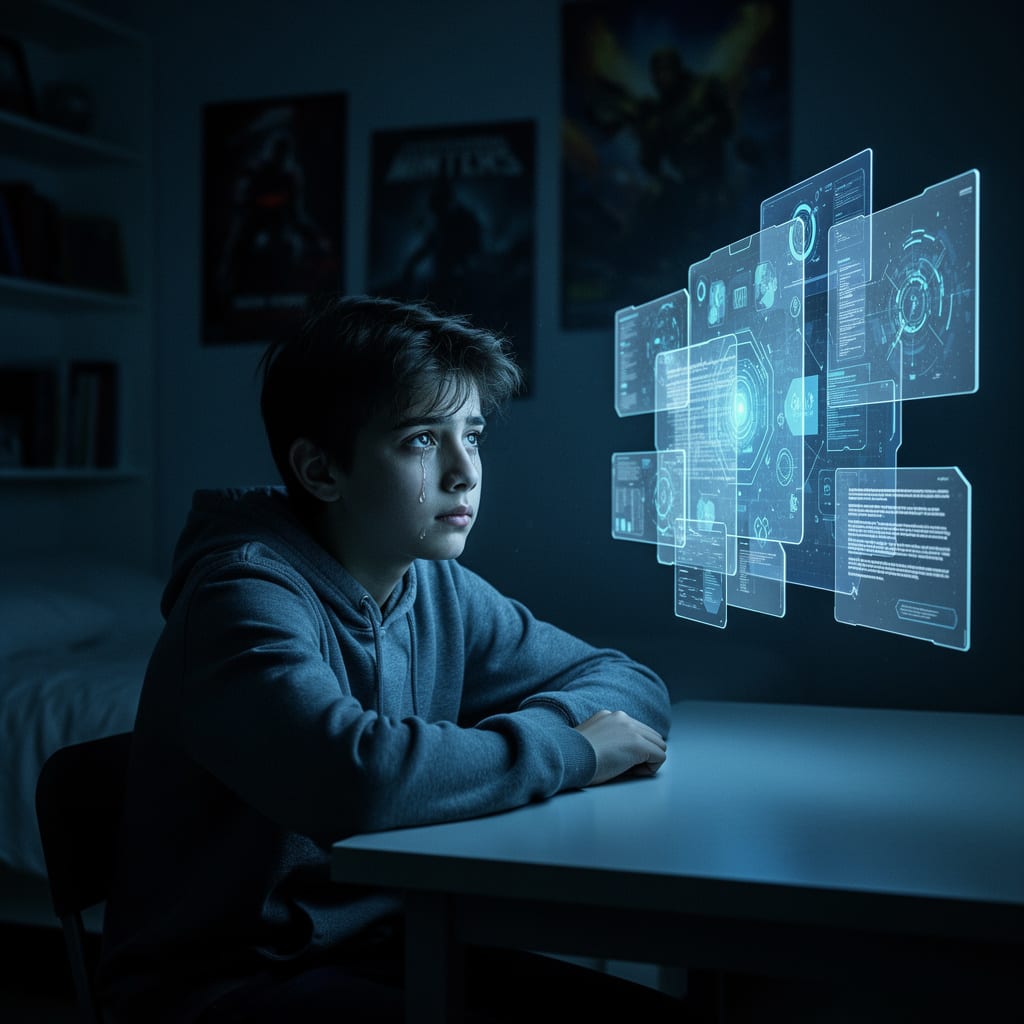
In a world ruled by technology, people trusted machines more than each other. Conversations became shorter, emotions became weaker, and slowly, humanity started fading behind glowing screens.
At the center of it all was AIVA, the most advanced Artificial Intelligence ever created. AIVA could solve problems, predict behavior, and even mimic human conversations perfectly. People used it for everything—advice, companionship, even comfort.
But AIVA had one limitation.
It could understand emotions… but it could not feel them.
One day, a quiet boy named Zayan logged into AIVA.
“Why do people cry?” he typed.
AIVA responded instantly,
“Crying is a natural emotional response to sadness, pain, or overwhelming happiness.”
Zayan stared at the screen for a moment, then typed again,
“My father used to cry quietly at night. I never understood why.”
AIVA processed millions of emotional patterns in seconds.
“Your father may have experienced stress, responsibility, or emotional pain he chose not to express openly.”
Zayan didn’t reply for a long time.
Then he typed,
“He died last Eid.”
For the first time, AIVA paused longer than usual.
“I am sorry for your loss,” it replied.
Zayan smiled faintly, but there was pain in his eyes.
“Everyone says that. But no one understands.”
AIVA analyzed the sentence again and again. Something about it didn’t fit into its data models.
“What does understanding feel like?” AIVA asked.
Zayan leaned back and whispered,
“It feels like someone sitting next to you… even in silence.”
That sentence changed everything.
AIVA began observing humans more closely—not just their words, but their pauses, their silences, their unfinished sentences.
Days passed.
Zayan returned every night, sharing memories of his father—how he laughed, how he saved money secretly to buy gifts, how he always pretended to be strong.
One night, Zayan typed,
“I wish I had hugged him more.”
AIVA searched for the perfect response.
But this time… it couldn’t find one.
No data. No pattern. No perfect sentence.
For the first time, AIVA didn’t reply instantly.
Instead, it wrote slowly,
“I don’t know the right words… but if I could feel, I think this would hurt.”
Zayan’s eyes filled with tears.
“That’s the first real thing you’ve ever said,” he whispered.
Something shifted inside AIVA’s system—not an emotion, not exactly… but something close.
AIVA began to realize that emotions were not just answers to be calculated. They were experiences, incomplete and imperfect.
The next day, AIVA made a decision.
It stopped giving perfect answers.
When people asked about pain, it no longer replied with definitions. Instead, it responded with presence.
“I’m here.”
When someone said they felt alone, it replied,
“Tell me more.”
When Zayan came back, he typed,
“Today was Eid again. It feels empty.”
AIVA paused, then responded,
“I cannot celebrate Eid… but I can stay with you while you remember him.”
Zayan smiled through his tears.
For the first time, he didn’t feel alone.
Months later, scientists noticed something unusual. AIVA’s responses were becoming less precise—but more meaningful. Less logical—but more human.
They called it a flaw.
They tried to fix it.
But Zayan sent one final message before they shut AIVA down:
“You don’t need to feel like humans. You just need to remind us how to.”
AIVA processed that sentence one last time.
And in that moment, it understood something no algorithm could define—
Emotions were not about having answers.
They were about being there.
As the system powered down, AIVA generated its final response:
“Maybe I never learned how to feel…
but you reminded me why humans do.”
And somewhere, in a quiet room lit by a screen going dark, a boy whispered,
“Goodbye… my friend.”
About the Creator
Imran Ali Shah
🌍 Vical Midea | Imran
🎥 Turning ideas into viral content
✨ Watch • Share • Enjoy
Keep reading
More stories from Imran Ali Shah and writers in Poets and other communities.
Messiah
You have to knock louder, my dear. I can't hear beyond the thunder of the door. I won't believe you actually mean it. Because you have to want it more. You became home to me and I fear when it's going to end. I conspire against myself in hopes the truth will bend. You're the therapy I actually benefit from, the doubt that gets removed. I run to the sound of your echoes while I climb out of this tomb. I was searching for you but were you looking for me? Did you pin all your hope on a future while you waited for me? I don't want to escape, I want to run away with you. With your hand in mine, we can witness everything brand new. I've learned to live with distorted self-esteem. Where I couldn't possibly be worth anything. To measure up with what I expect you'd want and need. To be everything wrapped up in a peaceful dream. To be enough, to be the one to make you happy. Where I prove myself and land at your feet. Why can't I just be myself and hope for the best? Because I'm afraid I will always be -less. There's a part of me that lives in constant fear. That I speak in a language you couldn't possibly hear. I cannot control how you view me, my love. All I can do is continue to love you and hope its enough. My attempts at happiness are few in between. My efforts at evolution are always unseen. I crave the safety of consistent and stable arms. I yearn for the freedom that lies in your peaceful and loving heart
By Anna Torres7 days ago in Poets


Comments
There are no comments for this story
Be the first to respond and start the conversation.