
The Ecosystem
Nobody Wanted Saved Everything


Why Swamps Are the Planet's Most Important and Most Misunderstood Landscape
THE WORLD'S MOST HATED ECOSYSTEM 🐊
For centuries human civilization has treated swamps, marshes, bogs, and wetlands as wastelands, as obstacles to progress that should be drained, filled, developed, and converted into productive land, and this attitude has resulted in the destruction of approximately sixty-four percent of the world's wetlands since 1900 with the rate of loss accelerating in recent decades despite growing scientific understanding that wetlands are not wastelands but rather among the most ecologically valuable and productive ecosystems on Earth, providing services worth an estimated forty-seven trillion dollars annually including water purification, flood protection, carbon sequestration, biodiversity support, and coastal storm buffering that no human technology can replicate at comparable scale or cost, and the continuing destruction of these ecosystems represents one of the most catastrophic environmental miscalculations in human history driven by the fundamental misunderstanding that an ecosystem's value is determined by its utility for agriculture or development rather than by its ecological function 🌍
The prejudice against wetlands is deeply embedded in human culture and language with "swamp" being used as a synonym for corruption, dysfunction, and decay across multiple languages and cultures, and politicians promise to "drain the swamp" as a metaphor for eliminating corruption without recognizing the irony that draining actual swamps has produced some of the most costly environmental disasters in human history including the subsidence of New Orleans below sea level after surrounding wetlands were drained for development making the city catastrophically vulnerable to the hurricane flooding that devastated it in 2005 and that would have been substantially mitigated if the wetlands that once buffered the city from storm surge had not been destroyed 🏚️
WHAT SWAMPS ACTUALLY DO 💧
The ecological services that wetlands provide are so extensive and so essential that scientists have described them as the planet's kidneys, filtering water, regulating flow, and removing pollutants with an efficiency that no wastewater treatment plant can match, and a single acre of wetland can filter and purify millions of gallons of water annually, removing nitrogen, phosphorus, heavy metals, and other pollutants through natural biological and chemical processes that cost nothing to operate and that function continuously without maintenance, and the destruction of wetlands upstream of cities and agricultural areas has produced water quality crises that municipalities now spend billions of dollars addressing through artificial treatment systems that imperfectly replicate what the wetlands did for free 🔬
The flood protection function of wetlands involves their capacity to absorb and slowly release massive volumes of water during heavy rainfall and storm events, functioning as natural sponges that reduce peak flood levels, slow water velocity, and distribute flood impacts over larger areas and longer timeframes, and the destruction of floodplain wetlands for development has directly contributed to the increasing severity and frequency of flood damage in many regions because the natural buffer that moderated flood impacts has been replaced by impervious surfaces that accelerate runoff and by developments built in areas that wetlands previously protected by absorbing the water that now inundates buildings and infrastructure 🌊
The carbon sequestration capacity of wetlands particularly peatlands is extraordinary and largely unrecognized, with peatlands covering only three percent of the Earth's land surface but storing approximately twice as much carbon as all the world's forests combined, and the destruction of peatlands through drainage for agriculture and development releases this stored carbon into the atmosphere as carbon dioxide contributing significantly to climate change, and the restoration of drained peatlands and the protection of remaining peatlands represents one of the most cost-effective climate mitigation strategies available because it both prevents carbon release and restores active carbon sequestration at minimal cost compared to technological carbon capture approaches 🌱
THE BIODIVERSITY HOTSPOT HIDING IN PLAIN SIGHT 🐸
Wetlands support disproportionate biodiversity relative to their area, providing habitat for approximately forty percent of all species on Earth despite covering only six percent of the planet's surface, and this extraordinary biodiversity concentration occurs because wetlands exist at the interface between aquatic and terrestrial ecosystems creating unique environmental conditions that support species adapted to both and that cannot survive in either ecosystem alone. The destruction of wetlands is a primary driver of global biodiversity loss with populations of wetland-dependent species declining by approximately eighty-one percent since 1970, a rate of decline that exceeds any other ecosystem type and that represents a catastrophic erosion of biological diversity that cannot be reversed because species extinction is permanent regardless of whether the habitat is eventually restored 🦆
The specific species that depend on wetlands include not just the conspicuous inhabitants like alligators, herons, and frogs but also commercially important fish and shellfish species that use wetlands as nursery habitat during juvenile life stages, migratory birds that depend on wetlands as stopover points during continental migrations and whose population declines correlate directly with wetland loss along their migratory routes, and countless invertebrate species that form the foundation of food webs supporting the larger more visible species that attract conservation attention 🐟
THE RESTORATION REVOLUTION 🔄
The recognition that wetland destruction has been ecologically catastrophic and economically counterproductive has driven a growing movement toward wetland restoration, with governments and organizations investing billions of dollars in recreating wetlands that were previously drained, and the results have been encouraging with restored wetlands recovering significant ecological function within five to ten years including water purification capacity, flood buffering, and habitat provision, though fully replicating the biodiversity and carbon storage of natural wetlands that developed over thousands of years requires much longer timeframes and may never be completely achieved because some ecological processes and species assemblages cannot be recreated once they are lost 🌿
The economic argument for wetland restoration is compelling because the ecosystem services that functional wetlands provide for free, water purification, flood protection, carbon sequestration, fisheries support, and recreational value, far exceed the economic value of the agricultural or development uses that the wetlands were destroyed to create, and cost-benefit analyses consistently show that protecting existing wetlands and restoring degraded ones produces returns on investment that exceed virtually any other environmental expenditure. The city of New York's decision to invest in protecting the wetlands and forests of its watershed rather than building a new water filtration plant saved approximately six to eight billion dollars in construction costs and produces higher quality water at lower ongoing cost, and this example has been replicated in numerous other cities that have recognized that natural infrastructure outperforms engineered infrastructure for water management at dramatically lower cost 💰
The lesson of the swamp is that human prejudice against certain landscapes has produced ecological and economic destruction that we are only beginning to understand and address, and that the ecosystems we considered worthless turn out to be among the most valuable on Earth, and that the impulse to drain and develop and improve natural systems reflects a fundamental misunderstanding of how ecosystems work and what they provide, and that humility about our understanding of nature's complexity and respect for ecosystems that do not conform to our aesthetic preferences are essential for avoiding the kind of catastrophic environmental miscalculation that wetland destruction represents 🌍💚✨
About the Creator
The Curious Writer
I’m a storyteller at heart, exploring the world one story at a time. From personal finance tips and side hustle ideas to chilling real-life horror and heartwarming romance, I write about the moments that make life unforgettable.
Keep reading
More stories from The Curious Writer and writers in The Swamp and other communities.
The Kindness Chain
THE FIRST LINK ☕ The chain began on a Monday morning in January in a Starbucks drive-through in Jacksonville, Florida, when a woman named Patricia Williams paid for the order of the car behind her as she collected her own coffee, a small act of generosity motivated by nothing more specific than the pleasant mood of a sunny morning and the impulse to share that pleasantness with a stranger, and she drove away without knowing the name of the person behind her or seeing their reaction when the barista told them their order had been paid for, and she did not know that this five-dollar act of spontaneous kindness would trigger a chain of paying-it-forward that would last for eleven hours involving three hundred and seventy-eight consecutive customers each paying for the order behind them in what the local media would call the longest pay-it-forward chain in Starbucks history, and she definitely did not know that the story of this chain when reported by local news would inspire similar chains at coffee shops, restaurants, and toll booths across the country and eventually around the world creating a network of small kindnesses linking strangers across continents and cultures through the simple act of paying for someone else's coffee ☕🌍
By The Curious Writerabout 9 hours ago in The Chain
The Forsyth House Fire
Since 1851, Forsyth House has stood on the corner of Union Street and Gordon Street in the heart of Glasgow. Its iconic, or was... because on Sunday 8th of March, 2026, a fire broke out in a small, seemingly un-named shop in the building and tore all that history down. As I write, the rubble is still unsettled and the street is still blocked off. Central Station is quiet on the upper level, and around 30 small businesses have quite literally gone up in smoke.
By S. A. Crawford23 days ago in The Swamp
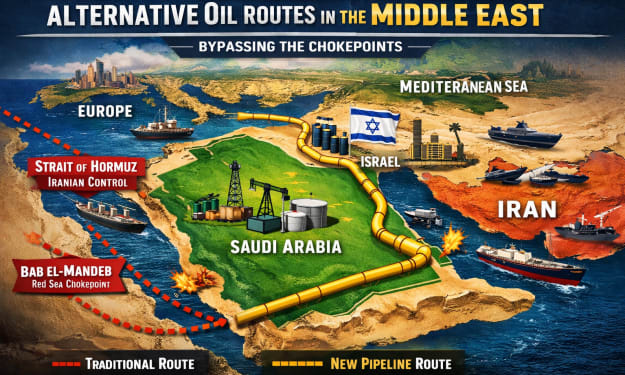
Saudi Arabia East- West Petroline
The Middle East has long been the center of global energy politics, with its vast oil and gas reserves shaping not only regional dynamics but also the priorities of major world powers. However, in recent years, a critical question has emerged: should the world continue relying on a few strategic maritime chokepoints for energy transportation, or is it time to develop alternative routes?
By Ibrahim Shah 6 days ago in The Swamp



Comments
There are no comments for this story
Be the first to respond and start the conversation.