
Global Desalination Market Set to Surge Amid Rising Water Scarcity
Governments, technology innovation, and climate pressures drive a multi-billion-dollar expansion through 2033

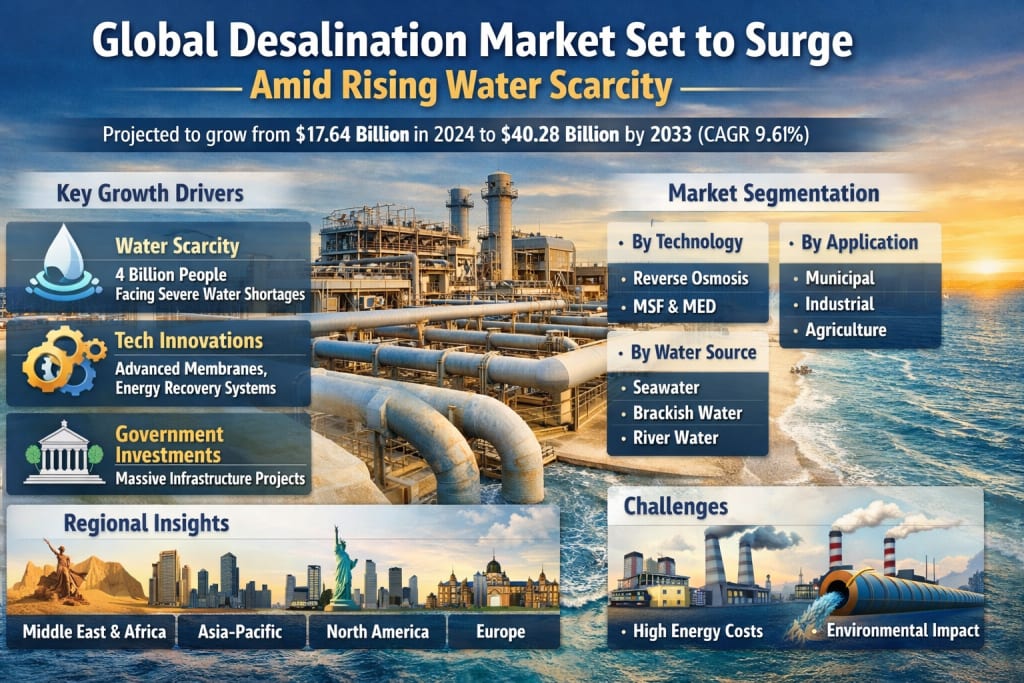
The global desalination market is entering a transformative phase, fueled by intensifying water scarcity, rapid urbanization, and growing industrial demand. As freshwater resources become increasingly strained, desalination is emerging as a critical solution to secure long-term water availability. According to recent industry analysis, the market is projected to grow from US$ 17.64 billion in 2024 to nearly US$ 40.28 billion by 2033, expanding at a robust compound annual growth rate (CAGR) of 9.61% between 2025 and 2033 .
This rapid growth reflects not only the urgency of global water challenges but also the increasing viability of desalination technologies, supported by innovation, policy frameworks, and strategic investments.
Understanding Desalination: Turning Saltwater into Lifelines
Desalination is the process of removing salts, minerals, and impurities from seawater, brackish water, or wastewater to produce fresh, potable water. It plays a vital role in regions where natural freshwater resources are insufficient or unreliable.
The two primary desalination approaches include:
Reverse Osmosis (RO): Uses semi-permeable membranes to filter out salts and impurities.
Thermal Desalination: Involves heating water to separate salts through evaporation and condensation.
Among these, reverse osmosis dominates due to its relatively lower energy consumption and cost efficiency.
Desalinated water is widely used across municipal, industrial, and agricultural sectors. In arid and semi-arid regions, it often serves as the backbone of national water supply systems, ensuring stability for both populations and economies.
A World Running Dry: The Core Growth Driver
The most powerful force behind the desalination market’s expansion is the growing global water crisis. With population growth, industrialization, and climate change accelerating water stress, the need for alternative water sources has never been greater.
Current estimates paint a stark picture:
Nearly 4 billion people experience severe water shortages for at least one month annually.
Over 2 billion people live in countries with inadequate water supply.
By 2025, half the global population could reside in water-stressed regions.
By 2030, up to 700 million people may face displacement due to water scarcity.
These alarming trends are compelling governments and industries to adopt desalination as a sustainable and scalable solution. Unlike rainfall-dependent systems, desalination offers a consistent and controllable water supply, making it indispensable in drought-prone areas.
Technology Evolution: Making Desalination Smarter and Greener
Technological advancements are playing a crucial role in transforming desalination from an expensive, energy-intensive process into a more efficient and environmentally responsible solution.
Key innovations include:
Advanced membrane technologies that enhance filtration efficiency while reducing energy consumption.
Energy recovery systems that capture and reuse energy during operations.
Digital twin technologies enabling real-time monitoring and optimization of desalination plants.
Automation and AI integration improving operational efficiency and reducing maintenance costs.
These developments are significantly lowering the cost per unit of desalinated water, making the technology accessible to a broader range of countries and industries.
A notable example is the increasing use of digital infrastructure to replicate and optimize desalination systems globally, enhancing scalability and consistency in performance .
Government Initiatives Fueling Market Expansion
Public sector involvement is another key catalyst for market growth. Governments worldwide are prioritizing water security through large-scale investments in desalination infrastructure.
Key policy and investment trends include:
Public-private partnerships (PPPs) to accelerate project development.
Subsidies and incentives to reduce financial barriers.
Strategic national water programs targeting long-term sustainability.
Regions such as the Middle East, North Africa, and Asia-Pacific are leading in desalination capacity expansion. Massive investments—often in the billions—are being directed toward building new plants and upgrading existing ones.
Additionally, international collaborations and funding initiatives are promoting knowledge sharing and supporting high-priority water projects across continents .
Market Segmentation: Diverse Applications Driving Demand
The desalination market is not monolithic; it spans multiple technologies, applications, and water sources, each contributing to overall growth.
By Technology
Reverse Osmosis (RO)
Multi-stage Flash (MSF) Distillation
Multi-effect Distillation (MED)
Others
Reverse osmosis continues to dominate due to its cost-effectiveness and adaptability across various applications.
By Application
Municipal: Supplying drinking water to urban populations.
Industrial: Supporting sectors like energy, manufacturing, and petrochemicals.
Others: Including tourism and agriculture.
Municipal applications account for a significant share, driven by urbanization and population growth.
By Water Source
Seawater
Brackish Water
River Water
Others
Seawater desalination leads the market due to the vast availability of ocean resources.
Industrial and Municipal Demand: A Dual Engine of Growth
Municipal Sector
Cities facing chronic water shortages are increasingly turning to desalination. Large-scale plants are being deployed to ensure uninterrupted water supply for households, public services, and urban infrastructure.
Municipal desalination is particularly critical in rapidly urbanizing regions, where traditional water sources cannot keep pace with demand.
Industrial Sector
Industries such as power generation, oil and gas, and manufacturing require massive volumes of water. Desalination provides a reliable and independent water source, reducing dependence on freshwater ecosystems.
Customized desalination solutions tailored to industrial needs are gaining traction, supported by innovations in energy efficiency and system design.
Regional Insights: Global Adoption Patterns
Middle East & Africa
This region dominates the global desalination landscape. Countries with limited natural freshwater resources rely heavily on desalination for survival. Advanced technologies and renewable energy integration are shaping the future of desalination here.
Asia-Pacific
Rapid urbanization and industrialization are driving demand. Coastal nations are investing heavily in seawater desalination plants to meet growing water needs.
North America
The United States is expanding its desalination footprint, particularly in water-scarce states like California, Texas, and Arizona. Investments in renewable-powered desalination are gaining momentum.
Europe
Europe focuses on sustainability and innovation. Countries like Germany are leading in energy-efficient desalination technologies, particularly for industrial applications.
Challenges: Energy, Cost, and Environmental Concerns
Despite its potential, desalination faces significant challenges that must be addressed for sustainable growth.
High Energy Consumption
Desalination is inherently energy-intensive, contributing to high operational costs. While technological advancements are reducing energy requirements, affordability remains a concern, especially for developing nations.
Environmental Impact
The discharge of brine—a concentrated salt byproduct—poses risks to marine ecosystems. Additionally, reliance on fossil fuels can increase carbon emissions.
Balancing water production with environmental sustainability is a critical challenge for the industry. Innovations in brine management and renewable energy integration are essential to mitigate these impacts.
Emerging Opportunities: Sustainability and Innovation
The future of desalination lies in its ability to align with global sustainability goals.
Promising trends include:
Solar-powered desalination plants reducing reliance on fossil fuels.
Hybrid systems combining desalination with wastewater treatment.
Decentralized desalination units for remote and rural areas.
Circular water systems promoting reuse and efficiency.
These innovations are not only addressing environmental concerns but also expanding the applicability of desalination across diverse geographies.
Competitive Landscape: Key Players Driving Innovation
The global desalination market features a mix of established corporations and emerging innovators. Leading companies are focusing on technological advancements, strategic partnerships, and geographic expansion to strengthen their market position.
Key players include:
Acciona
Dow
Evoqua Water Technologies
Siemens AG
DuPont
Doosan Enerbility
Toray Industries, Inc.
Xylem
These companies are investing heavily in research and development, aiming to improve efficiency, reduce costs, and enhance sustainability.
Final Thoughts: A Critical Solution for a Water-Stressed Future
The global desalination market is no longer a niche segment—it is rapidly becoming a cornerstone of global water infrastructure. As climate change intensifies and freshwater resources dwindle, desalination offers a reliable and scalable solution to one of humanity’s most pressing challenges.
With strong market growth projections, continuous technological innovation, and increasing government support, the desalination industry is poised for significant expansion in the coming decade.
However, the path forward requires a careful balance between meeting water demand and protecting environmental ecosystems. Investments in clean energy, sustainable practices, and advanced technologies will be crucial in shaping a resilient and responsible desalination future.
In a world where water scarcity is becoming the new normal, desalination stands as a powerful tool—transforming oceans into opportunity and ensuring that access to clean water remains within reach for generations to come.
About the Creator
A System That Isn’t Working Challenge Winners
Systems promise order. They organize behavior, distribute opportunity, and suggest that if everyone follows the rules, things will work. The entries in A System That Isn’t Working look closely at what happens when that promise begins to slip.
By Vocal Curation Team7 days ago in Resources




Comments
There are no comments for this story
Be the first to respond and start the conversation.