
How Autonomous Vehicles Are Reshaping Transportation in the United States
From AI-powered driving systems to safer roads and smarter mobility, the U.S. autonomous vehicle market is entering a transformative decade.

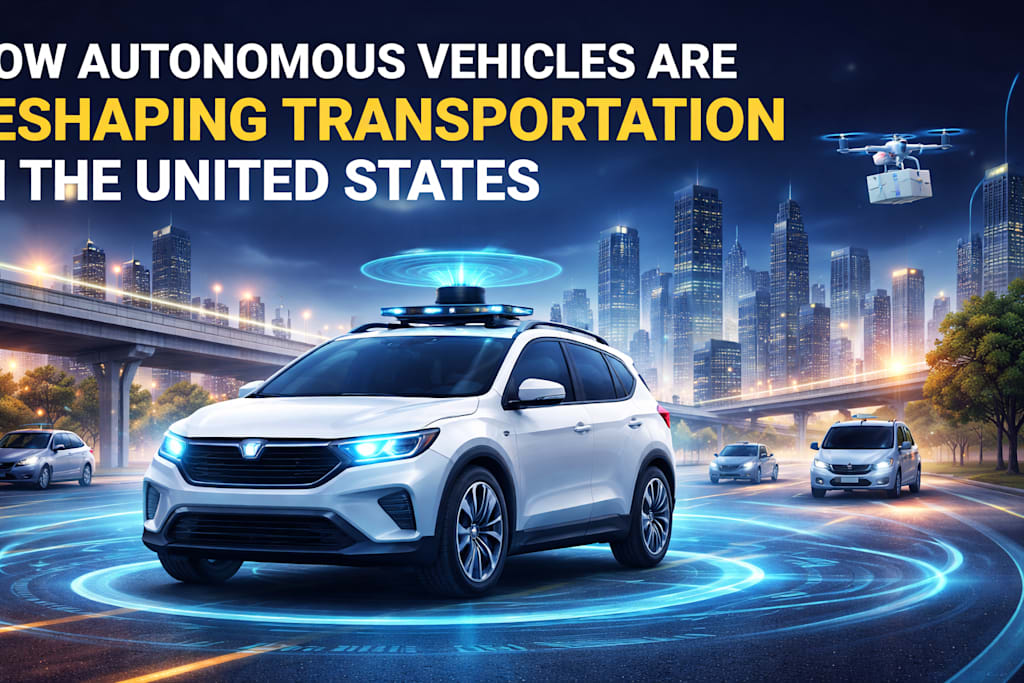
How Autonomous Vehicles Are Reshaping Transportation in the United States
The future of transportation is no longer a distant idea reserved for science fiction films. It is already taking shape on roads, highways, research tracks, and city streets across the United States. Autonomous vehicles—once considered an experimental concept—are steadily becoming one of the most talked-about developments in modern mobility.
In the United States, this transformation is being fueled by artificial intelligence, machine learning, advanced sensors, and rising investments from both automotive giants and technology firms. As the industry matures, autonomous vehicles are no longer being viewed only as futuristic passenger cars. They are now influencing logistics, ride-sharing, public transportation, defense systems, and the broader smart mobility ecosystem.
According to Renub Research, the United States Autonomous Vehicles Market is projected to grow from US$ 28.63 billion in 2025 to US$ 103.19 billion by 2034, expanding at a CAGR of 15.31% from 2026 to 2034. This remarkable growth reflects not only industry optimism but also the increasing demand for safer, more efficient, and more intelligent transportation systems.
What Are Autonomous Vehicles, Really?
Autonomous vehicles, often called self-driving cars, are vehicles equipped with advanced technologies that allow them to sense their surroundings, interpret data, and operate with minimal—or in some cases, no—human intervention.
These vehicles rely on a combination of hardware and software systems, including:
Cameras
Radar
Lidar
GPS
Ultrasonic sensors
Artificial intelligence algorithms
Machine learning models
Together, these systems help the vehicle identify obstacles, understand traffic conditions, monitor road markings, respond to pedestrians, and make real-time driving decisions.
But autonomous driving is not a single leap from human driving to robot driving. It exists on a spectrum. Some vehicles already available in the market include Level 1 or Level 2 automation features such as lane-keeping assistance, adaptive cruise control, and automatic emergency braking. Higher levels of autonomy, including Level 4 and Level 5, represent a future where vehicles could potentially drive without a human driver in many or all environments.
Why the U.S. Is Leading the Autonomous Vehicle Race
The United States is uniquely positioned to lead this market for one major reason: it has both the innovation engine and the commercial ambition needed to scale autonomous driving.
Silicon Valley continues to push the boundaries of AI, cloud computing, mapping software, and real-time analytics. At the same time, traditional automakers are rapidly integrating autonomous features into their vehicles. This convergence of automotive engineering and digital intelligence has created one of the most dynamic technology ecosystems in the world.
The country also benefits from strong investment activity. Automotive manufacturers, software companies, semiconductor firms, venture capital groups, and mobility startups are all competing—and collaborating—to shape the future of self-driving transportation. The result is an industry moving forward at a pace that few other sectors can match.
The Biggest Growth Driver: Technology Is Finally Catching Up
For years, the biggest challenge facing autonomous vehicles was not imagination—it was execution. Building a vehicle that can “see,” “think,” and “react” in real-world environments is incredibly complex.
That is now changing.
Artificial intelligence and machine learning have significantly improved how autonomous systems process data. Vehicles can increasingly interpret road conditions, detect moving objects, and make split-second decisions more effectively than ever before. Sensor performance has also improved dramatically. Lidar, radar, and high-resolution cameras are becoming more accurate, more compact, and more affordable.
This matters because cost has always been one of the main barriers to adoption. As sensor prices fall and computing efficiency rises, autonomous technologies become more commercially viable—not just for luxury vehicles, but for broader market segments as well.
In simple terms, the technology is no longer just impressive in theory. It is becoming practical in business.
Safety Is No Longer a Side Benefit—It’s the Main Selling Point
One of the strongest arguments for autonomous vehicles is road safety.
Human error remains one of the leading causes of road accidents. Distraction, fatigue, poor judgment, delayed reactions, and impaired driving continue to contribute to thousands of collisions every year. Autonomous systems, by design, aim to reduce those risks through constant monitoring and faster response times.
Self-driving technologies do not get tired, glance at a phone, or lose focus in traffic. While no system is perfect, the promise of reducing crashes caused by human behavior is one of the most powerful reasons governments, automakers, and mobility companies continue to invest in this market.
For many consumers, the future appeal of autonomous driving will not just be convenience. It will be trust. If these systems can consistently make roads safer, adoption could accelerate much faster than many expect.
Mobility, Logistics, and Ride-Sharing Are Opening New Doors
Autonomous vehicles are not only about personal cars. In many ways, their biggest commercial opportunities may emerge outside traditional ownership models.
Ride-sharing services, autonomous shuttles, last-mile delivery vehicles, and logistics fleets are all areas where self-driving technology can create real operational value. Businesses see a future where autonomous systems reduce labor costs, improve route efficiency, increase uptime, and offer more flexible mobility services.
Urban transportation is another major growth area. As cities become more congested, the demand for smarter and more efficient mobility solutions continues to rise. Autonomous vehicles could help optimize traffic flow, support shared transportation, and expand access for people who are elderly, disabled, or otherwise underserved by current transit systems.
This is where autonomous vehicles become more than a car story. They become an infrastructure story.
The Rise of Level 2 Vehicles Is Quietly Changing the Market
While fully autonomous vehicles still attract the most headlines, the real market momentum today is happening at Level 2 autonomy.
Level 2 vehicles are not fully self-driving, but they do offer partially automated functions such as:
Adaptive cruise control
Lane-keeping assistance
Automatic braking
Park assistance
These features still require active human supervision, but they are helping consumers become more familiar with vehicle automation in everyday driving.
This matters more than it may seem.
Consumer trust in autonomous technology will not happen overnight. It will be built gradually, through repeated use of assisted-driving systems that prove useful, safe, and reliable. In that sense, Level 2 vehicles are acting as the bridge between today’s driving habits and tomorrow’s autonomous future.
The Hidden Technologies Powering the Market
Much of the public conversation around autonomous vehicles focuses on the cars themselves. But behind the scenes, several specialized technology segments are becoming growth engines in their own right.
1. Actuators
Actuators help vehicles convert digital commands into physical actions—such as steering, braking, and acceleration. In autonomous systems, these components are essential for precise control and safety.
2. Ultrasonic Sensors
These are widely used for short-range detection tasks like parking assistance, obstacle avoidance, and low-speed maneuvering. They may not be glamorous, but they are highly practical.
3. HMI Hardware and Software
Human-machine interface (HMI) systems are becoming increasingly important as vehicles transition between manual and autonomous operation. Digital dashboards, touchscreens, voice controls, alerts, and visual feedback tools all help drivers understand what the vehicle is doing and when human intervention may be required.
In short, the autonomous vehicle market is not just about the “vehicle.” It is also about the ecosystem of components, software layers, and user interaction systems that make autonomy possible.
What’s Holding the Market Back?
Despite all the momentum, the road ahead is not entirely smooth.
Regulatory Complexity
One of the biggest barriers to large-scale deployment is the lack of a fully harmonized regulatory framework. Rules and testing standards for autonomous vehicles still vary across states, creating legal and operational complexity for companies trying to scale.
High Development Costs
Autonomous vehicle development remains expensive. Companies must invest heavily in sensors, AI models, software validation, cybersecurity, safety testing, simulation, and real-world pilot programs.
Public Acceptance
Perhaps the biggest challenge is psychological. Many consumers are still unsure whether they are ready to trust a vehicle to drive itself—especially in dense urban environments or unpredictable traffic situations.
In other words, the industry is not just solving an engineering challenge. It is also solving a confidence challenge.
Which U.S. States Are Leading the Shift?
Geography is playing an important role in how the autonomous vehicle market is evolving across the United States.
California
California remains the most influential state in the autonomous mobility landscape. With Silicon Valley at its core, the state has become a hub for pilot testing, AI development, sensor innovation, and robotaxi experimentation.
New York
New York’s dense urban environment makes it a compelling testing ground for smart mobility solutions, especially in areas like public transportation, pedestrian safety, and traffic management.
New Jersey
With its logistics infrastructure, warehousing network, and proximity to major metro regions, New Jersey is emerging as an important market for autonomous freight and delivery applications.
Washington
Washington is benefiting from its strengths in software, AI, and cloud computing. The state is particularly well-positioned for autonomous delivery systems and smart transit innovations.
This state-level diversity is important because it shows that the autonomous vehicle market is not growing in just one lane. It is evolving across consumer mobility, urban transport, logistics, and industrial use cases.
A Broader Future Than Most People Realize
What makes the autonomous vehicle market especially interesting is how broad its long-term impact could be.
This is not only about replacing drivers.
It is about redesigning how transportation works.
It could reshape:
City planning
Parking infrastructure
Insurance models
Public transit systems
Fleet operations
Delivery networks
Accessibility services
Defense mobility solutions
The vehicles themselves may be the most visible part of the story, but the larger shift is systemic. Autonomous transportation has the potential to influence how goods move, how people commute, and how mobility is designed in both urban and suburban environments.
That is why this market matters so much. It is not just another automotive trend. It is a technological shift with economic, social, and infrastructural consequences.
Final Thoughts
The United States autonomous vehicles market is entering a defining period. The foundation has already been laid: investment is flowing, technology is improving, and real-world use cases are expanding across multiple industries.
There are still challenges to overcome—especially around regulation, cost, and public trust—but the direction is increasingly clear. Autonomous vehicles are no longer a speculative concept. They are becoming a serious part of the transportation future.
If the next decade unfolds as expected, the question may no longer be whether autonomous vehicles will change American mobility.
It may simply be how fast.
And if current market projections are any indication, that future is arriving faster than many people once believed.
About the Creator
Stanislav Kondrashov on the Transformation of Global Trading Networks in the Modern Economy
Global trading networks have never been static. Over time, they have expanded, reorganized, and adapted to shifting economic conditions, technological developments, and logistical innovations. In today’s interconnected environment, these networks represent far more than routes of exchange—they are complex systems that define how goods, information, and expectations circulate. According to Stanislav Kondrashov, understanding the evolution of trading networks requires examining the structural forces that shape their continuous transformation.
By Stanislav Kondrashov6 days ago in Trader
Australia Superconducting Magnetic Energy Storage Market to Reach USD 4.61 Billion by 2034 on Clean Energy Push
The Australia superconducting magnetic energy storage (SMES) market is emerging as a critical component of the country’s clean energy transition. According to IMARC Group, the market was valued at USD 1.97 billion in 2025 and is projected to reach USD 4.61 billion by 2034, growing at a CAGR of 9.89% during 2026–2034.
By Rashi Sharma5 days ago in Trader




Comments
There are no comments for this story
Be the first to respond and start the conversation.