Latest Stories
Most recently published stories in Chapters.
Pakistan–Afghanistan Border Tensions Escalate: Taliban Claims Retaliatory Strikes After Pakistani Airstrikes in Kabul, Kandahar
Taliban government spokesperson Zabihullah Mujahid announced in a post on X that Pakistani forces had carried out bombings in parts of Kabul, Kandahar, and Paktia.
By Real contentabout a month ago in Chapters
Afghanistan’s Taliban Penal Code: Hudud, Tazir, and the Expansion of Judicial Powers
In Geneva, the agenda of the 61st annual session of the United Nations Human Rights Council, which began today (Thursday, February 27), included the Taliban government’s penal code. The Council’s Commissioner, Volker Türk, referred to the Taliban’s criminal code and the punishments it contains.
By Real contentabout a month ago in Chapters
How Power Structures Protect Themselves
In 1949, a book was written titled Nineteen Eighty-Four, in which George Orwell fictionally explained how, in the future, systems and governments would become so powerful that they would prioritize their own power struggles over people’s well-being. And remember, we’re talking about the West, where democracy is considered very mature. According to Orwell, such states never truly end conflicts or wars; one way or another, they keep fear alive among people. If fear remains intact, people stay obedient.
By Ibrahim Shah about a month ago in Chapters
Allocating for Prosperity: How Strategic Asset Allocation Fuels Enduring Wealth
Strategic asset allocation forms the foundation of long-term wealth creation because it determines how investors distribute capital across major asset classes. Rather than chasing short-term market trends, this approach establishes a structured mix of equities, fixed income, real assets, and other investments that aligns with clear objectives. Therefore, investors who commit to strategic allocation create a roadmap that guides decisions through changing economic conditions.
By Winston Fengabout a month ago in Chapters
Andrew Carnegie: From Immigrant to Steel Tycoon
Andrew Carnegie was born on November 25, 1835, in Dunfermline, Scotland, a town that had once been wealthy but was declining by the mid-19th century. His father, William Carnegie, was a handloom weaver, a craft that was rapidly disappearing due to the rise of industrialized steam-powered looms. As a result, the family faced severe poverty, forcing Andrew’s mother, Margaret, to work long hours mending shoes and running a small grocery shop to make ends meet. These early experiences instilled in Carnegie a profound awareness of social inequality and a lifelong determination to rise above hardship. Witnessing the struggles of the working class inspired his later belief that wealth should be used to improve society.
By Haroon Pashaabout a month ago in Chapters
Firebug: Ch. 21 - The Queen Bee's Sting
Roman dropped Theo off back home a few minutes before dawn. There was just enough time for him to slip through the window and tiptoe to his room before he heard Thaddeus wake up and get ready for work. Theo laid in bed and stared at the ceiling until he heard his father leave the apartment, unable to stop smiling.
By Natalie Grayabout a month ago in Chapters
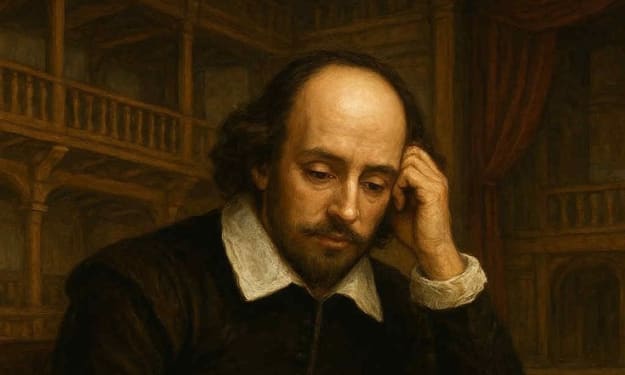
William Shakespeare Biography: Life, Works, and Legacy of the Greatest English Playwright
Imagine a world without Romeo and Juliet, Hamlet, or Macbeth. No famous line “To be, or not to be”, no tragic lovers, no powerful kings falling from pride, and no timeless lessons about life and love. Hard to imagine, right? Yet all these treasures came from one man born in a quiet English town more than 400 years ago. William Shakespeare rose from ordinary beginnings to become the most influential writer in the history of literature. His words crossed borders, centuries, and cultures, speaking equally to kings and common people.
By Haroon Pashaabout a month ago in Chapters
Albert Einstein: The Genius Who Changed the Universe
Albert Einstein (14 March 1879 – 18 April 1955) was a German-born theoretical physicist whose ideas transformed our understanding of the universe. Best known for the theory of relativity and his mass–energy equivalence formula E = mc², Einstein’s work laid the foundation for modern physics. He also made groundbreaking contributions to quantum theory, statistical mechanics, and cosmology. In 1921, he received the Nobel Prize in Physics for his explanation of the photoelectric effect, a discovery that would pave the way for quantum mechanics.
By Haroon Pashaabout a month ago in Chapters