energy
How politicians and governments around the world are dealing with climate change, solar energy and harnessing renewable resources.
The "Benefits Cliff"
The System Is Not Cash, It Is Replacement For a family of five in Salem, Oregon, the low-income support system is not built primarily on direct cash transfers. It is built on a small number of high-impact programs that function as after-tax purchasing power, replacing major expenses rather than adding to pre-tax income. This distinction matters because it changes how the system must be evaluated. Income is taxed before it becomes usable, while benefits replace costs that would otherwise require after-tax dollars. That means these programs effectively operate as a parallel income structure, but one that is locked into specific categories such as food, housing, childcare, and healthcare rather than flexible cash.
By Peter Thwing - Host of the FST Podcast2 days ago in The Swamp
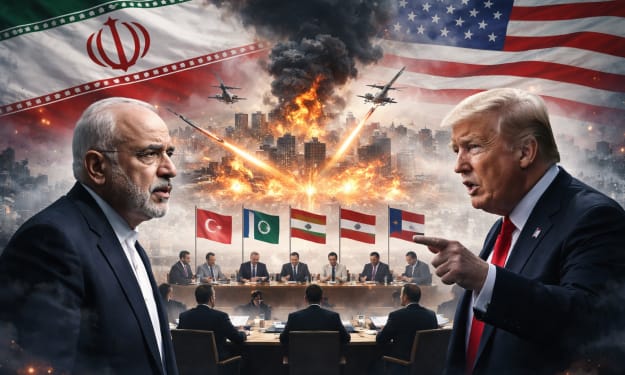
Four Countries Four Different roles in peace talk of US -Iran War
In the current global landscape, the Middle East has once again emerged as the center of international politics and economic concern. Rising tensions in the region have alarmed major world powers, highlighting the importance of certain countries that possess not only geographical significance but also strategic and diplomatic leverage. Among these, Pakistan, Turkey, Egypt, and Saudi Arabia stand out as key players capable of influencing the course of events.
By Ibrahim Shah 3 days ago in The Swamp
Saudi Arabia East- West Petroline
The Middle East has long been the center of global energy politics, with its vast oil and gas reserves shaping not only regional dynamics but also the priorities of major world powers. However, in recent years, a critical question has emerged: should the world continue relying on a few strategic maritime chokepoints for energy transportation, or is it time to develop alternative routes?
By Ibrahim Shah 8 days ago in The Swamp
War, Diplomacy, and Power Politics:
The ongoing tensions between Iran and the United States have entered a complex and multidimensional phase, where military escalation and diplomatic maneuvering are unfolding simultaneously. While the battlefield remains active, a parallel track of negotiations, mediation efforts, and summit proposals is gaining momentum, signaling that global powers are seeking to prevent a full-scale regional war.
By Ibrahim Shah 11 days ago in The Swamp
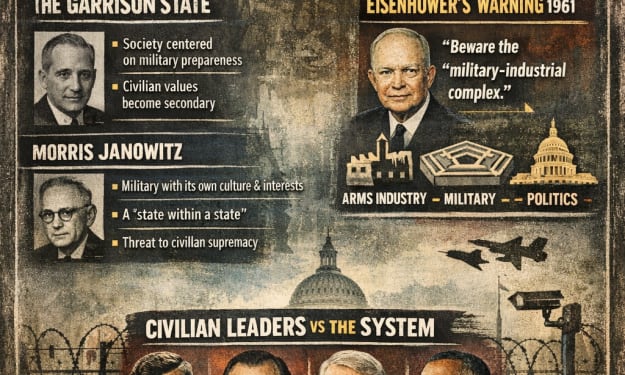
Militarization, Civilian Authority, and the Challenge to Democratic Governance
In modern political systems, one of the most subtle yet profound transformations occurs when societies gradually internalize a military mindset. This shift is not always visible, nor does it happen abruptly. Instead, it unfolds quietly, as civilians begin to perceive the world through the lens of security, threat, and strategic competition. Over time, the distinction between civilian and military leadership can erode, raising critical questions about the future of democratic governance.
By Ibrahim Shah 12 days ago in The Swamp
The Economic Shockwaves of Middle East Conflict
Dubai has long been regarded as a global hub for gold trade and finance, but the ongoing conflict in the Middle East has begun to shake even its strongest economic pillars. With flight operations disrupted and regional instability rising, the ripple effects of war are now being felt across multiple sectors—from energy and aviation to tourism and global finance.
By Ibrahim Shah 14 days ago in The Swamp
I Updated My iPhone to the Latest iOS for 7 Days. Here’s What It Really Did to My Battery Life.
“Your phone doesn’t just install an update — it rebuilds half its brain in the background, and your battery pays the price for days, not hours.” “If you judge battery life in the first 24 hours after an update, you’re not testing the update — you’re testing the chaos.” “Your phone heating up in your pocket is your battery screaming for help — spike first, percentage second.” “Updates don’t just change your battery numbers — they change how and when your phone spends energy.” “Your goal isn’t perfect battery life. It’s predictable battery life — that’s what actually gives you peace of mind.”
By abualyaanart16 days ago in The Swamp
Difficult Night for Israel: Netanyahu.
Israeli Prime Minister Benjamin Netanyahu described Iran's bombardment of Dimona and Arad as a "difficult night" for the Jewish state. Dimona houses Israel's nuclear programme and alleged nuclear weapon armaments. Arad, another settlement not far from Dimona, was also hit badly. Why did Iran strike Dimona in particular? Earlier on, Iran's nuclear site Natanz had been attacked by either US or Israeli munitions or both. So Iran struck back in kind at a nuclear facility in Israel. The IAEA, or the International Atomic Energy Agency, stated that there appeared to be no nuclear leakage from Natanz. And as for Dimona, the Iranian projectiles missed the nuclear site and landed around the area adjacent to the nuclear site, not direct hits. Israel never signed the nuclear non-proliferation treaty and is very coy about whether it has nuclear weapons or not. Therefore, the IAEA wouldn't be allowed to inspect the nuclear facilities. So, because the Iranian projectiles missed the Domina nuclear site, one would suspect there is no danger of leakage.
By Nicholas Bishop16 days ago in The Swamp
Why the United States Temporarily Eased Sanctions on Iranian Oil
In a surprising and strategically calculated move, the United States recently decided to temporarily ease sanctions on Iranian oil exports. This decision comes at a time when global energy markets are under immense pressure due to escalating tensions around the Strait of Hormuz—one of the world’s most critical maritime chokepoints for oil transportation. The move, though limited in scope and duration, reflects the complex balance between geopolitical strategy and economic necessity.
By Ibrahim Shah 17 days ago in The Swamp
John Major Condemns the Iran War.. Content Warning.
I can't say I've cared for many Conservative prime ministers. Most, if not all, Tory leaders have been enemies of the working class, despite the ethos of one-nation Conservatism. Look at the last shower of Tory leaders we have had before Sir Keir Starmer took the keys of No 10. However, I actually didn't mind John Major, who became prime minister after the fall of Margaret Thatcher. Unlike many Tories, John Major was not from the Oxbridge set. Sir John Major was born in Brixton and came from a fairly ordinary background. He worked his way to the top and replaced Thatcher. Major and his wife seemed like they could have lived next door to you. Nothing controversial about them or scandalous. The most you could say about the Majors is that they were dull and boring. But compared to the last 5 Conservative prime ministers, we have had, starting with David Cameron and ending with Rishi Sunak, I'd rather have had dull and boring.
By Nicholas Bishop17 days ago in The Swamp
Trump: Considering Occupying Kharg Island.
When Israel and the US decided on 28 February to take military action against Iran, they were in for a shock, or so it seems. The policy of decapitation of enemy leadership has always been Israel's policy. Countless leaders that Israel regards as enemies have been assassinated in this way. Whether from Mossad, the IDF, the Israeli Air Force, whatever. The US, of late, has also adopted this policy. The reasoning being that killing the leaders of an enemy organisation or country will cut off the head of the snake. The problem with that is the snake grows another head. When Israel killed Hezbollah Chief Hasan Nasrallah, yes, it shook the group to its very foundations. But the group under a new leadership is battling Israel in Lebanon now as we speak.
By Nicholas Bishop18 days ago in The Swamp
The Great Reset: The Fed to The Family
The Great Reset: From "The Fed" to "The Family" For almost a century, the U.S. Dollar has been backed by aircraft carriers and the "full faith and credit" of a government. But the Trump Crime Syndicate has realized that "full faith" is a sucker’s game. They are systematically breaking the old fiat system—the one owned by the "Globalist" banking elite—to install a privatized, tokenized, and Trump-branded global reserve currency.
By Meko James 19 days ago in The Swamp