education
A place to hash out all opinions on education policy, charter schools, statewide testing, and what the political world is and isn't doing about it.
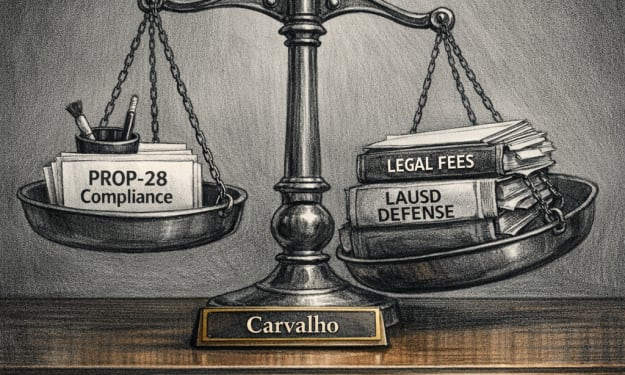
The "Benefits Cliff"
The System Is Not Cash, It Is Replacement For a family of five in Salem, Oregon, the low-income support system is not built primarily on direct cash transfers. It is built on a small number of high-impact programs that function as after-tax purchasing power, replacing major expenses rather than adding to pre-tax income. This distinction matters because it changes how the system must be evaluated. Income is taxed before it becomes usable, while benefits replace costs that would otherwise require after-tax dollars. That means these programs effectively operate as a parallel income structure, but one that is locked into specific categories such as food, housing, childcare, and healthcare rather than flexible cash.
By Peter Thwing - Host of the FST Podcastabout 13 hours ago in The Swamp
The Ecosystem
Why Swamps Are the Planet's Most Important and Most Misunderstood Landscape THE WORLD'S MOST HATED ECOSYSTEM 🐊 For centuries human civilization has treated swamps, marshes, bogs, and wetlands as wastelands, as obstacles to progress that should be drained, filled, developed, and converted into productive land, and this attitude has resulted in the destruction of approximately sixty-four percent of the world's wetlands since 1900 with the rate of loss accelerating in recent decades despite growing scientific understanding that wetlands are not wastelands but rather among the most ecologically valuable and productive ecosystems on Earth, providing services worth an estimated forty-seven trillion dollars annually including water purification, flood protection, carbon sequestration, biodiversity support, and coastal storm buffering that no human technology can replicate at comparable scale or cost, and the continuing destruction of these ecosystems represents one of the most catastrophic environmental miscalculations in human history driven by the fundamental misunderstanding that an ecosystem's value is determined by its utility for agriculture or development rather than by its ecological function 🌍
By The Curious Writerabout 19 hours ago in The Swamp
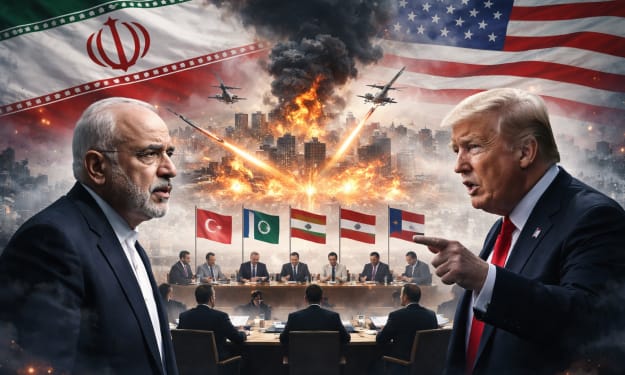
Four Countries Four Different roles in peace talk of US -Iran War
In the current global landscape, the Middle East has once again emerged as the center of international politics and economic concern. Rising tensions in the region have alarmed major world powers, highlighting the importance of certain countries that possess not only geographical significance but also strategic and diplomatic leverage. Among these, Pakistan, Turkey, Egypt, and Saudi Arabia stand out as key players capable of influencing the course of events.
By Ibrahim Shah a day ago in The Swamp
Saudi Arabia East- West Petroline
The Middle East has long been the center of global energy politics, with its vast oil and gas reserves shaping not only regional dynamics but also the priorities of major world powers. However, in recent years, a critical question has emerged: should the world continue relying on a few strategic maritime chokepoints for energy transportation, or is it time to develop alternative routes?
By Ibrahim Shah 7 days ago in The Swamp
No Kings Protest NYC: Voices Rising in the Streets
There are moments when a city becomes more than buildings and traffic. It becomes a place where people gather to speak, to stand, and to be heard. The No Kings protest NYC is one of those moments. It is not just an event. It is a reflection of how people feel when they believe power is being misused or voices are ignored. Streets that usually carry noise and routine suddenly fill with purpose. People arrive from different backgrounds, yet they stand together with a shared message. The No Kings protest NYC shows how ordinary individuals can come together to express concern, frustration, and hope. To understand it fully, you have to look beyond the headlines and see the human stories behind the movement.
By Muqadas khan8 days ago in The Swamp
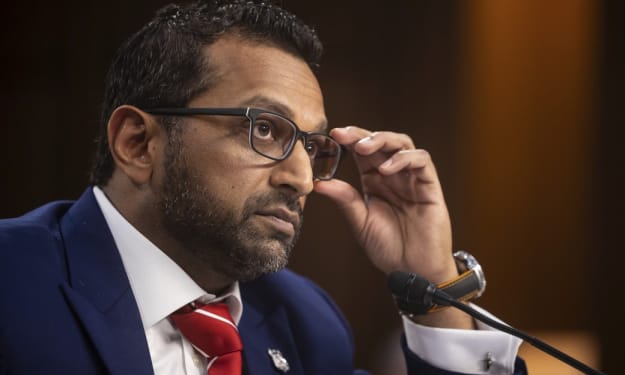
Kash Patel: Power, Controversy, and a Political Journey
Some political figures rise quietly, working behind the scenes before suddenly becoming widely known. Others attract attention because of the roles they play during tense moments in government. Kash Patel is one of those names that began in the background but quickly moved into public discussion. For many people, his story is not simple or easy to define. It involves law, national security, politics, and strong opinions from both supporters and critics. The name Kash Patel often appears in conversations about power and decision-making in Washington. But beyond headlines and debates, there is a personal journey shaped by ambition, loyalty, and difficult choices. To understand Kash Patel, it is important to look at the path that brought him into the center of political attention.
By Muqadas khan9 days ago in The Swamp
War, Diplomacy, and Power Politics:
The ongoing tensions between Iran and the United States have entered a complex and multidimensional phase, where military escalation and diplomatic maneuvering are unfolding simultaneously. While the battlefield remains active, a parallel track of negotiations, mediation efforts, and summit proposals is gaining momentum, signaling that global powers are seeking to prevent a full-scale regional war.
By Ibrahim Shah 10 days ago in The Swamp
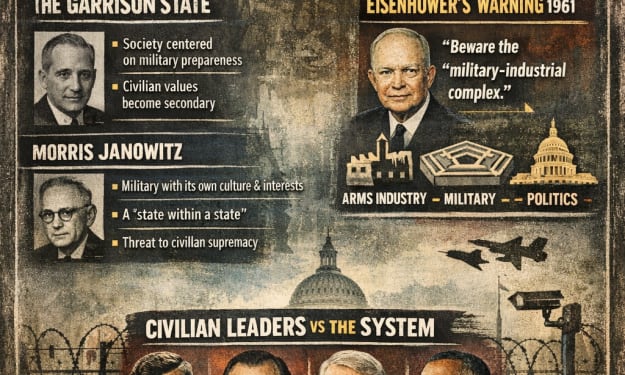
Militarization, Civilian Authority, and the Challenge to Democratic Governance
In modern political systems, one of the most subtle yet profound transformations occurs when societies gradually internalize a military mindset. This shift is not always visible, nor does it happen abruptly. Instead, it unfolds quietly, as civilians begin to perceive the world through the lens of security, threat, and strategic competition. Over time, the distinction between civilian and military leadership can erode, raising critical questions about the future of democratic governance.
By Ibrahim Shah 10 days ago in The Swamp
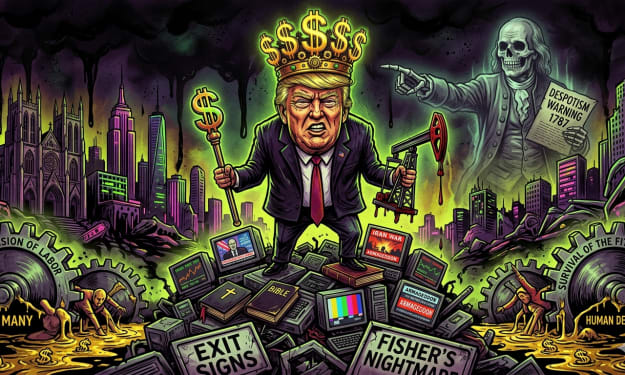
THE GREAT AMERICAN EXORCISM: MASKING DESPOTISM IN THE CHURCH OF CAPITAL
I. The Neon Purgatory of the Now There is a smell in the air these days, and it isn’t just the scent of cheap cologne and burning diesel. It’s the ozone of a dying circuit board. We are living in Mark Fisher’s nightmare, a state of Capitalist Realism enveloped in smoke so thick you can’t even see the exit signs. Fisher famously warned that it is easier to imagine the end of the world than the end of capitalism, and we have taken that psychic trap to its ultimate, blood-soaked conclusion. Because we cannot conceive of a world beyond the market, we have decided to monetize the apocalypse itself. This is why you see the "Christian Nationalists" currently screaming for Hell-fire in the Middle East; they aren't seeking salvation, they are cheering for Armageddon in Iran as the ultimate market exit strategy. We’ve turned the end of the world into a subscription service, and the "faithful" are just waiting for the final installment to download... because they are the only ones good enough to be saved from the global fire we just created.
By Meko James 11 days ago in The Swamp
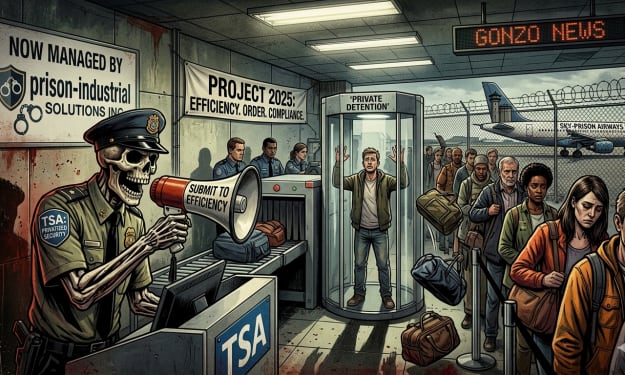
THE SKY-PRISON COMMUTE: THE GREAT AMERICAN AIRPORT SHAKEDOWN
LOS ANGELES, CALIFORNIA — I am standing in a security line at Los Angeles International Airport, staring into the dead, glazed eyes of a man who has been screaming "LAPTOPS OUT" for six straight hours. Currently, he is a federal employee. He has a pension. He has health insurance. But if the ghouls behind Project 2025 have their way, this man is about to be "liberated". By liberated, I mean he’s about to be fired, stripped of his union card, and rehired at $18.00 an hour by a subsidiary of a private equity firm that also manages an "enhanced detention center" in the Mojave Desert, that's conveniently housing all the dangerous undocumented immigrants, and keeping "America Safe"... again.
By Meko James 12 days ago in The Swamp
The Economic Shockwaves of Middle East Conflict
Dubai has long been regarded as a global hub for gold trade and finance, but the ongoing conflict in the Middle East has begun to shake even its strongest economic pillars. With flight operations disrupted and regional instability rising, the ripple effects of war are now being felt across multiple sectors—from energy and aviation to tourism and global finance.
By Ibrahim Shah 13 days ago in The Swamp